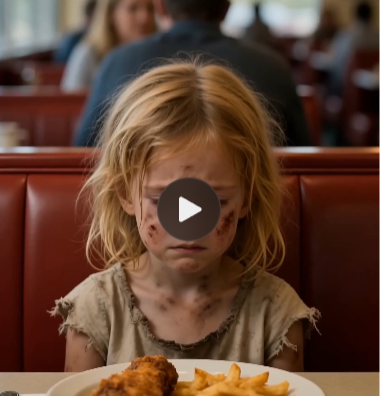
For a moment, the waitress couldn’t move.
The diner noise seemed to drift far away—the clink of forks, the hum of the refrigerator, the low voices from the booths. All of it blurred into something distant and muffled, because the woman standing across from her no longer felt like a stranger.
There was something in her eyes.
Something familiar.
The kind of familiarity that doesn’t come from memory first—but from feeling.
The waitress lowered the dish towel in her hands.
The businesswoman swallowed hard and reached into her purse. When she opened her palm, two old coins rested there, dull with age and worn nearly smooth by time.
The waitress stared at them.
And suddenly she wasn’t standing behind the counter anymore.
She was back in that afternoon years ago, holding a plate of chicken and fries, looking down at a frightened little girl trying not to cry in booth seven.
Her breath broke.
“No…” she whispered, but this time it wasn’t confusion. It was recognition arriving all at once.
The businesswoman nodded, tears finally spilling over.
“I kept them,” she said softly. “The only money I had that day.”
The waitress lifted one shaking hand to her mouth.
The woman gave a sad smile. “You fed me before I had anywhere to sleep. Before anybody knew my name. Before I had school, before I had a job, before I believed I could be anything.”
The old waitress looked down at the keys again, then at the folded document.
“What is this?” she asked, though her voice was already trembling with fear of the answer.
The businesswoman unfolded the paper and turned it toward her.
The waitress adjusted her glasses. Her eyes moved slowly across the page.
Then stopped.
Her knees nearly gave out.
It was the deed to the diner.
Not a threat. Not a lawsuit. Not a notice.
Ownership papers.
The diner had been bought—paid in full—and signed over to her.
The waitress looked up so fast her chair scraped behind her.
The businesswoman continued before the shock could turn into protest.
“You worked here thirty-two years. You stayed after everyone else left. You covered shifts when you were sick. You lost part of your pay that day because you chose kindness over fear.” Her voice cracked. “I asked around. I found out they never gave it back.”
The waitress’s eyes flooded.
“I also found out,” the woman said, sliding a second document forward, “that the owners were planning to sell this place in two weeks. They were going to close it and let you go with nothing.”
The old woman’s lips parted, but no sound came.
“So I bought it first.”
The waitress just stared.
The businesswoman’s polished composure finally fell away, revealing the child she had once been.
“I built a life because one day, when everyone else looked away, you didn’t.” She smiled through tears. “You gave me food, but that’s not what saved me. You gave me dignity. And when a child gets dignity at the right moment… sometimes it keeps her alive.”
The waitress broke then.
Not with loud sobbing—just with that quiet, shattered crying that comes when a person has carried too much for too long and suddenly someone sets part of it down for them.
She reached for the papers, but her hands trembled too hard.
The businesswoman came around the counter and gently held them for her.
“There’s more,” she whispered.
The waitress looked up.
“A retirement fund in your name. Full health coverage. And if you want to keep this diner open, you’ll never have to do it alone again. If you want to rest…” Her voice softened even more. “Then it’s time you finally can.”
The old waitress cried harder.
Around them, the few customers who had overheard the exchange sat in stunned silence. A young cook near the kitchen doorway quietly wiped his eyes. Even the new server at the register had stopped pretending not to listen.
The waitress stared at the woman’s face, searching through the years until she found the little girl again—the one with the dirt-smudged cheeks and hungry eyes and trembling lips.
“You really came back,” she whispered.
The businesswoman laughed softly through tears.
“I told you I wouldn’t forget.”
The waitress pulled her into her arms.
And in that tired old diner, between faded green walls and worn leather booths, the child who once left with a full stomach returned as the woman who came back carrying a future.
Not because kindness asked to be repaid.
But because real kindness is never lost.
It lives inside people.
It grows quietly.
And one day, when the moment is right, it comes home.