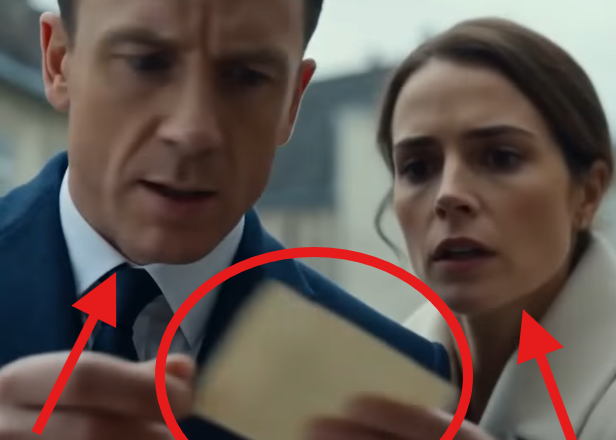
Julian couldn’t move.
The pastry was still in his hand, crumbs on his lips, warmth turning cold in his chest.
Inside the locket was a tiny photograph.
A baby asleep against the old woman’s shoulder.
On the back, almost erased by time, were four words.
My son. My Julian.
His partner stepped backward.
Too fast.
Julian saw it.
“Claire,” he said quietly. “Why are you scared?”
She shook her head.
“I’m not.”
But her eyes had already betrayed her.
Across the street, a black car pulled to the curb.
The old woman saw it and went pale.
“They found us.”
Julian turned.
Behind the rain-streaked window sat an elderly man in a dark coat.
His father.
The man who had raised him with cold rules, clean lies, and a framed photograph of a grave Julian never visited because it hurt too much.
The car door opened.
His father stepped out slowly, leaning on a silver cane, his eyes fixed not on Julian…
but on the old woman.
“You should have stayed gone,” he said.
Julian’s breath stopped.
Not because he doubted her anymore.
Because his father had just confirmed everything.
The old woman gripped the cart as if the street might fall from under her.
“I stayed alive,” she whispered. “That was all I could do.”
Julian turned toward his father, voice shaking.
“You told me she died when I was three.”
His father’s face remained hard.
“She was poor. She sold pastries in the street. I gave you a future.”
The old woman flinched like he had struck her.
Julian looked at the recipe card again.
At the birthday.
At the name.
At the food his body remembered before his mind did.
“You gave me a future without my mother.”
His father’s mouth tightened.
Claire stepped beside the old man.
That was when Julian understood why she had tried to take the card.
“You knew?”
Claire’s eyes filled, but she didn’t answer.
His father did.
“Her family helped protect ours.”
The street became silent around him.
The woman he was going to marry had known the woman selling pastries outside cafés was his mother.
And had walked past her.
Maybe more than once.
The old woman reached under the cart and pulled out a small cloth bundle.
Inside was a child’s blue sweater, folded with impossible care.
“I kept it,” she said. “You wore it the last morning I held you.”
Julian touched the sweater.
His hands began to shake.
A memory flashed.
Not clear.
Not complete.
Just warmth.
Flour on a cheek.
A song hummed badly.
A woman laughing while hiding tears.
His father stepped closer.
“Get in the car.”
Julian looked at him.
Then at the pastry cart.
Then at the old woman who had spent years feeding strangers the recipe she once made for a son stolen from her.
He took off his expensive coat and placed it gently around her shoulders.
His father’s face hardened.
“Julian.”
But Julian wasn’t looking at him anymore.
He was looking at the old woman.
The mother he had mourned while she was still breathing in the same city.
His voice broke.
“Did you wait for me?”
She smiled through tears.
“Every morning.”
Julian covered his mouth.
“And when I didn’t come?”
Her hand trembled against his cheek.
“I baked again the next day.”