The mirror slipped from her lap and cracked on the pavement.
No one moved.
The sound was small, but it cut through the park like glass breaking inside a quiet room.
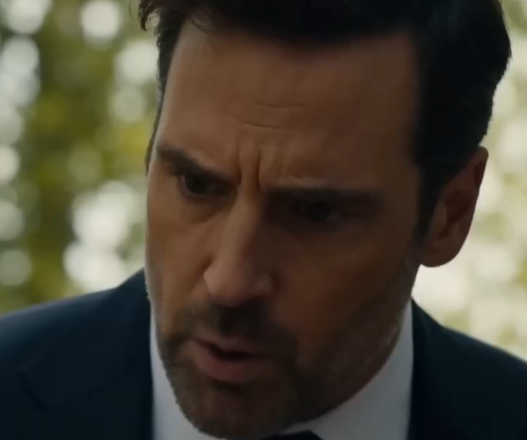
The father stared at the camera in his hand.
Then at his daughter’s shaved head.
Then at his fiancée.
She lifted both hands, already preparing the soft voice she used when she wanted him to doubt himself.
“She’s confused. She’s been very emotional.”
The girl flinched.
The father saw that too.
The boy tightened his grip on the wheelchair handles.
“She says that every time,” he said.
The fiancée turned on him.
“You don’t belong here.”
The boy’s eyes filled with tears, but he didn’t step back.
“She asked me to check the chair.”
The father looked down at his daughter.
“You asked him?”
The girl nodded slowly.
Her voice was barely there.
“I thought maybe if it recorded it… someone would believe me.”
That sentence destroyed him.
Not loudly.
Not all at once.
It hit his face in pieces.
First guilt.
Then horror.
Then the realization that his child had stopped asking adults for help and started collecting evidence instead.
He pressed play.
The tiny screen lit up.
At first, only the park path from another day.
Then the house.
A bedroom mirror.
His daughter sitting in the wheelchair, crying softly, hands folded in her lap.
The fiancée’s voice came through the camera.
“Hold still.”
The father stopped breathing.
On the video, his daughter whispered, “Please don’t.”
The fiancée answered, calm and cold.
“If you look sick, he stays close. If he stays close, we keep the house.”
The father’s hand shook so hard the camera almost fell.
The girl covered her ears.
The boy moved beside her and whispered, “You don’t have to listen.”
The fiancée reached for the father’s arm.
“I did it for us.”
He stepped away from her like her touch hurt.
“For us?”
His voice was quiet.
Deadly.
“She is seven.”
The fiancée’s face cracked.
“She gets all your attention.”
The father stared at her, unable to understand how jealousy could wear such a beautiful face for so long.
The girl whispered, “She said if I told you, you would send me away.”
The father dropped to his knees in front of the wheelchair.
He didn’t touch her right away.
He waited.
Like he understood, too late, that love had to ask permission after fear.
“May I hold your hand?”
The girl looked at him.
Then slowly reached out.
The moment her fingers touched his, she started crying.
Not silently this time.
Not carefully.
Like a child who had finally been allowed to make sound.
The boy looked away, wiping his face with his sleeve.
The father turned toward him.
“What’s your name?”
“Leo.”
The father nodded through tears.
“Leo, you protected my daughter when I didn’t.”
The boy’s lip trembled.
“She was my friend.”
The fiancée began backing away.
But the father lifted the camera.
“It already uploaded.”
She froze.
The girl looked up.
“To who?”
The father’s eyes filled with pain and rage.
“To my lawyer.”
Then he looked at the fiancée, the woman who had smiled beside him while turning his daughter’s fear into a costume.
“And to the police.”
The fiancée’s face went white.
Behind them, the charity event speakers crackled in the distance, announcing her name for the children’s fundraiser.
The father looked toward the stage.
Then at his daughter.
Then at the cracked mirror on the ground.
His voice softened.
“Do you want to go home?”
The girl shook her head.
The answer broke him again.
“No,” she whispered. “I want everyone to know I was never sick.”
The father stood slowly, still holding her hand.
The boy stayed behind the wheelchair.
And together, they turned toward the event tents.