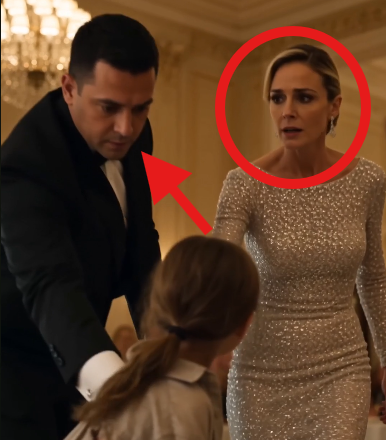
The woman’s tears fell into the open watch.
For a moment, she couldn’t move.
The restaurant was still full of music, candles, gold light, and expensive perfume, but all she could smell was sugar burning in an old kitchen.
Mara.
The pastry chef she had accused.
The woman whose recipe had made this restaurant famous.
The woman everyone called difficult after she refused to sign away her work.
The girl held the apron tighter.
“My mom said you might not remember her face.”
The woman looked at the framed photo again.
The empty space beside her younger self suddenly looked louder than the picture itself.
“I remembered,” she whispered.
The girl’s eyes filled.
“Then why didn’t you fix it?”
That question hit harder than any accusation.
The head waiter lowered his eyes.
A few older staff members looked away.
They knew.
They had always known.
The woman stood slowly and walked toward the stage microphone, still holding the pocket watch.
The charity host tried to stop her.
“Madam, maybe later—”
“No.”
One word.
The room obeyed.
She stepped into the spotlight.
Her voice shook at first.
“Years ago, this restaurant won its first award for a dessert I did not create.”
Guests turned silent.
The little girl stood near the dessert cart, clutching the apron like a piece of her mother that could still protect her.
The woman continued.
“The chef who created it was named Mara Vale. I accused her of stealing a watch because I was afraid she would expose me.”
A gasp moved through the room.
The head waiter covered his mouth.
The woman looked straight at the child.
“She was innocent.”
The girl’s lips parted.
“She left this restaurant with nothing but that apron, that watch, and a recipe everyone here kept selling.”
The investor’s voice finally broke.
“And her daughter came tonight to return the one thing I never deserved to keep.”
She opened the watch again.
Inside, behind the photo, was a tiny folded paper.
Mara’s handwriting.
If she ever tells the truth, don’t let her cry alone.
The woman could not finish reading.
The little girl walked toward the stage slowly, afraid of every eye in the room.
The woman knelt before her in the spotlight.
Not as an investor.
Not as the rich woman in the silver gown.
As someone finally small enough to ask forgiveness.
“I am sorry,” she whispered.
The girl stared at her.
For a long second, nobody breathed.
Then the girl said,
“My mom said sorry doesn’t feed children.”
The woman closed her eyes.
“She was right.”
She stood, turned to the guests, and removed the diamond bracelet from her wrist.
“The charity donation tonight begins with everything this restaurant earned from Mara’s recipe.”
The room erupted in stunned whispers.
The woman placed the bracelet beside the old apron.
“And her daughter decides where it goes.”
The girl looked at the watch.
At the apron.
At the woman crying in front of everyone.
Then she whispered,
“Start with the kitchen workers.”
The investor nodded through tears.
And for the first time in that restaurant, Mara’s name was not hidden behind gold frames, stolen recipes, or polite lies.
It was spoken aloud.
And everyone stood for the woman who wasn’t there to hear it.