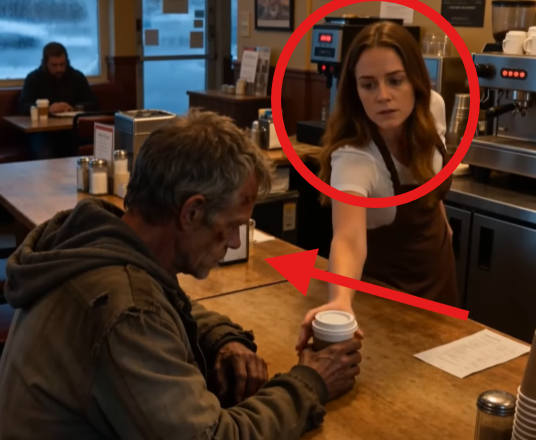
The cashier stared at the receipt.
“What do you mean he paid for yours?”
The biker placed it gently on the counter.
“He came in before me.”
The homeless man lowered his eyes.
“Please,” he whispered. “It’s okay.”
But the biker shook his head.
“No. It’s not.”
The cashier looked at the receipt again. Two coffees. One muffin. Paid in cash.
Her face started to change.
The biker turned toward the customers.
“He counted coins for almost a full minute. Then when he saw me checking my pockets, he told the cashier to add mine.”
The homeless man’s lips trembled.
“You looked tired,” he said quietly.
The biker swallowed, his voice softening.
“I was tired. My daughter’s in the hospital across the street. I’d been there all night.”
The cashier’s hand slowly lowered with the cup.
The homeless man finally looked up.
“My wife died in that hospital,” he said. “Years ago. Cold mornings still bring me back here.”
The room went still.
“I used to buy her coffee from this shop before visiting hours. She said it made the room smell like home.”
The cashier covered her mouth.
He gave a sad little smile.
“Today I had enough for one coffee. Then I saw him sitting there, looking like I used to look. So I bought two.”
The biker’s eyes filled.
“You didn’t even know me.”
The homeless man shook his head.
“Pain knows pain.”
The cashier placed the cup back in front of him with both hands.
“I’m sorry,” she whispered.
He nodded, but his fingers shook when he touched it.
Then the biker stood, took a folded bill from his wallet, and placed it on the counter.
“Coffee for him every morning this week.”
The homeless man looked down, overwhelmed.
“No. Please. I don’t want pity.”
The biker sat beside him.
“It’s not pity,” he said. “It’s a thank-you.”
Outside, the cold morning pressed against the glass.
Inside, the man who had been treated like he didn’t belong warmed his hands around the coffee he had already paid for.