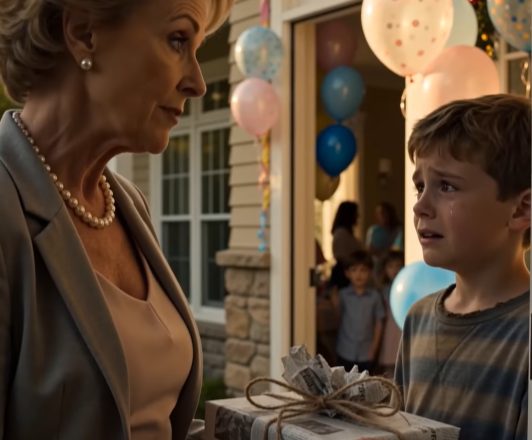
The wealthy mother couldn’t move.
“What do you mean… saved you?”
The birthday boy pushed past her and ran onto the steps.
He grabbed the poor boy’s hand like he was afraid he might leave.
“You didn’t tell her?” the poor boy whispered.
The birthday boy shook his head, tears filling his eyes.
“I tried. She never listened.”
His mother’s face changed.
The boy turned to her.
“Last month, after soccer practice, everyone left. My chest got tight. I couldn’t breathe.”
The mother’s hand rose slowly to her mouth.
“I thought the coach called you.”
“No,” her son whispered. “He did.”
He pointed at the poor boy.
“He stayed with me. He gave me his jacket because I was shaking. He ran all the way to the gas station to call for help because my phone was dead.”
The poor boy looked down.
“I just didn’t want him to be alone.”
The mother stared at the handmade gift, now bent where she had shoved it.
“What’s inside?”
The poor boy hesitated.
Then he slowly opened the torn brown paper.
Inside was a small cardboard picture frame, carefully glued together by hand. In it was a drawing of two boys sitting on a curb, one wrapped in an old jacket, the other holding his hand.
Under the drawing, in crooked letters, he had written:
Best friends don’t leave.
The mother’s eyes filled with tears.
She looked at the gift.
Then at the boy she had treated like he didn’t belong.
“I’m sorry,” she whispered.
The poor boy didn’t answer.
He just held the crushed frame carefully, like it still mattered.
The birthday boy wiped his face and looked at his mother.
“You bought me everything today,” he said. “But he was the only one who came for me when I needed somebody.”
The mother stepped aside from the doorway.
This time, her voice was soft.
“Please come in.”
The poor boy looked unsure.
Then the birthday boy took the gift from his hands and held it to his chest.
“No,” he said through tears. “He doesn’t come in because we feel sorry for him.”
He looked at his mother.
“He comes in because he’s my friend.”