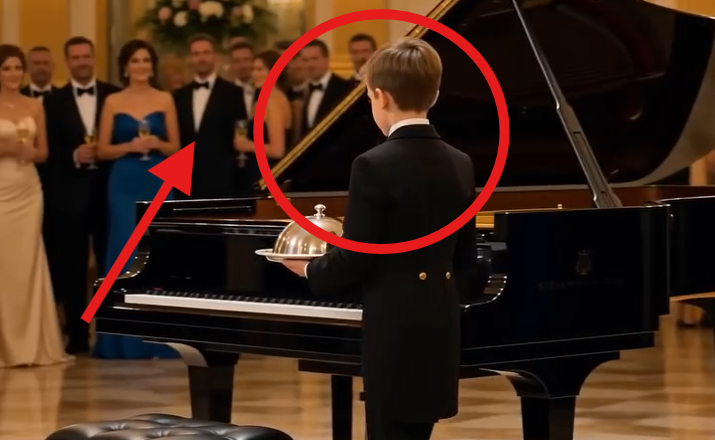
Oliver rose from the piano bench so quickly it scraped the floor.
“No,” he whispered. “My mother said she had no family.”
The old man flinched as though the child had struck him.
“She believed that because I let her believe it.”
The ballroom had fallen completely silent, but Oliver no longer saw the chandeliers or the staring guests.
He saw his mother sitting at their kitchen table, counting coins before pretending she was not hungry.
He saw her worn hands guiding his across cheap plastic piano keys.
He remembered the last night she was strong enough to speak.
Some people live in palaces and still choose not to open the door.
Oliver’s eyes filled with hurt.
“She cleaned houses when she was sick,” he said quietly. “I started working here because medicine cost too much.”
The older man closed his eyes.
A tear ran down his face.
“I didn’t know.”
Oliver’s voice grew smaller.
“She came to you, didn’t she?”
The man’s shoulders dropped.
“Years ago.” His breath shook. “She fell in love with someone I thought was beneath our family. I told her if she walked out with him, she was no longer my daughter.”
Oliver gripped the edge of the piano.
“And when he died?”
The man looked down at the floor.
“She wrote to me. She said she had a little boy.” His face crumpled. “I returned the letter unopened.”
A soft gasp passed through the ballroom.
Oliver stood very still.
His mother had not been forgotten.
She had been rejected.
“She kept your photograph,” he whispered. “Even when we had no food, she wouldn’t sell the frame.”
The old man pressed a hand over his mouth, breaking under the weight of it.
“I was proud,” he sobbed. “And she paid for it with her whole life.”
Oliver reached into his waiter’s pocket and removed a tiny folded piece of paper, worn thin from being opened too many times.
“My mother asked me to carry this if I ever found the man who knew her melody.”
The older man’s shaking fingers unfolded it.
Inside, in Isabelle’s fading handwriting, were only a few words:
“Dad, I taught your grandson our song. Please don’t turn him away too.”
The old man sank to his knees on the marble floor.
Oliver tried to stay strong, but his chin trembled.
“I didn’t come here looking for money,” he whispered. “I just wanted someone to remember her.”
The man lifted his tear-soaked face.
“I remember everything now,” he said. “Too late for my daughter… but not too late to love her child.”
Oliver stared at him for a long moment.
Then he slowly sat back at the piano.
His fingers found the melody again, softer this time.
The old man stayed kneeling beside him, crying openly as the notes filled the ballroom.
And for the first time since Isabelle died, her little boy was no longer playing their family song alone.