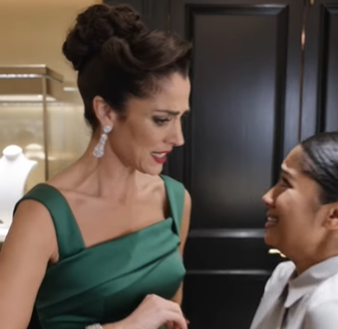
The silence was heavier now than the accusation had been. Only seconds earlier, the rich woman’s certainty had controlled the room. She had been loud, elegant, furious, and expensive — all the things people in places like that too often confuse with authority. The sales assistant, by contrast, had been young, poor, frightened, and in uniform. That made her easy to shame, easy to overpower, and easy for others to imagine guilty. But now the bracelet was no longer missing, and the story that had seemed so simple was splitting open in the middle of the showroom.
The assistant stood frozen where she had been dragged, one hand still pressed to her cheek, her torn pocket hanging open at her side. Tears continued to fall, but her face had changed. Fear was still there, yes, but now shock had joined it — the deeper kind, the kind that arrives when humiliation suddenly collides with a truth you were never prepared to hear. She looked from the bracelet to the repair receipt to the woman in emerald, as if the three things together had stopped making sense as separate objects and become part of one revelation.
The older jeweler did not hurry. Men like him, especially those who had spent decades watching wealthy families try to polish their scandals into elegance, knew when silence was already doing the hardest work. He explained that the bracelet had not been stolen, misplaced, or taken from the display floor by staff. It had been in the workshop exactly where it was supposed to be, because it had been brought in earlier that day for clasp restoration and stone security inspection. What made him stop when he saw the service order was not the piece itself — though he remembered it immediately — but the family name attached to the old archive reference linked to it.
That name, he said, had not appeared in the boutique’s records for twenty years.
At once, a murmur ran through the customers.
The woman in emerald opened her mouth, but nothing came out.
The jeweler continued. Two decades earlier, the bracelet had been custom-made for a woman from a prominent family — a woman who came into the boutique late in her pregnancy, requested a flexible inner setting for future resizing, and asked that the bracelet be filed under her maiden family name rather than her married one. It had been an unusual request at the time, memorable enough that he never forgot it. The woman had laughed softly when he asked why. She said only that some names are safer kept where no husband can erase them. Then, years later, the bracelet disappeared from the boutique’s records after a family split no one in Milan society ever fully explained.
The assistant stopped breathing for a second.
The jeweler turned toward her with a look that held more sorrow than surprise now.
“When I saw you last month,” he said, “I thought you only resembled her.”
The rich woman in emerald visibly stiffened.
“But tonight,” he went on, “when I saw the archive name on the receipt and looked at your face again… I understood.”
The room leaned inward.
The assistant’s lips parted.
“My mother?” she whispered.
The jeweler nodded slowly.
“Yes.”
That single word changed everything.
What had begun as a luxury-boutique theft scandal was no longer about a missing bracelet at all. It was about inheritance, identity, and a family history that had clearly been buried long enough for one daughter to grow up in wealth and another to grow up in a uniform. The customers could feel it. The staff could feel it. And worst of all for the woman in emerald, the entire room could now feel that her rage had come too fast to be innocent.
Because if the bracelet belonged to a family line connected to both women, then her violence was no longer simply a mistake.
It began to look like recognition.
The assistant tried to steady herself against the counter edge, but her hand shook too badly. She said she had been raised by her grandmother after her mother died young. She said she knew her mother had once worked around wealthy people in Milan, but no one had ever told her much more. There were no heirlooms in her home, no jewelry boxes, no elegant stories. Only a surname her grandmother had spoken carefully, as though it carried both pride and danger. She had used that same surname on her employment papers because it was the only real thing she believed she had been given.
The jeweler closed his eyes briefly, then opened the service file in his hand.
The bracelet, he explained, had been brought in that afternoon not by the assistant, but by the woman in emerald’s personal driver, acting on instructions from her household. The official request had been made under a current client account, but the restoration match triggered the old archive record from twenty years earlier. That was why the family name reappeared. That was why he recognized it. And that was why, when he stepped out into the showroom and saw a girl with that same face and that same name being slapped in public over the piece, he understood at once that something far uglier than theft was happening in his boutique.
The woman in emerald looked as though the room itself were pressing inward on her.
“That proves nothing,” she said, but even she could hear how weak it sounded.
The jeweler’s gaze sharpened.
“No,” he said quietly. “Your face does that.”
A soft gasp moved through the customers.
He explained then what everyone had already begun to suspect: the resemblance between the two women was not vague or sentimental. It was exact in the cruelest places — the shape of the eyes, the line of the jaw, the way both of them held tension in the mouth when frightened. He had seen it the moment the assistant lifted her face through tears. The kind of resemblance families pretend not to recognize until someone else says it aloud.
Now the room understood why the rich woman had gone pale.
Not because the bracelet had been found.
Because the past had.
The assistant looked directly at the woman in emerald now, and for the first time since the slap, the older woman did not look away out of contempt. She looked away out of fear. That told the room more than any denial could have done. She knew. Maybe not every detail. Maybe not every year or every paper or every lie told in elegant houses. But enough. Enough to panic the moment that bracelet, that face, and that old family name entered the same space.
The jeweler then revealed the final detail — the one that turned scandal into something almost unbearable. Tucked into the archive notes attached to the original commission was a handwritten instruction from the mother herself: If ever resized again, adjust for both daughters. At the time, he had assumed it was sentiment, the dream of a pregnant woman imagining the future. Now, standing in a boutique where one daughter wore couture and the other wore a name tag, the line landed like a confession from the dead.
The assistant covered her mouth.
The woman in emerald shut her eyes.
And the room saw it.
This had never been about a stolen bracelet.
It had been about a rich woman seeing an object from her mother’s past in the hands of a jeweler… then seeing the girl behind the counter with the same blood in her face… and choosing violence before recognition could become public. The sales assistant had not been accused because evidence pointed toward her. She had been accused because the truth did.
One by one, customers began lowering their phones.
Not because the scene had become less dramatic.
Because it had become harder to keep pretending they were only watching entertainment.
The assistant bent slightly and picked up the bus ticket that had fallen from her torn pocket. Then the hand cream. Then the pen. Such small, ordinary things. Evidence of a life built on shifts, wages, and public politeness. And they had been spilled onto black marble under diamond light because someone wealthier needed a poorer girl to become a shield against family shame.
The jeweler stepped closer to the assistant, not touching her, but standing between her and the woman who had just struck her. It was the first act of protection anyone had offered her all night. He said, clearly enough for the entire boutique to hear, that no client of his — no matter how old the account, how famous the surname, or how expensive the gown — would ever again lay a hand on his staff to silence a private scandal.
The woman in emerald looked as though she wanted to speak, to deny, to reassert herself, to crush the moment back into something she could control.
But there was no room left for control.
Only exposure.
The assistant was still crying.
Still shaken.
Still humiliated.
Still holding the torn edge of her pocket.
But she was no longer shrinking.
When she finally looked at the woman who had slapped her and called her a thief, her voice came out quiet — so quiet the whole boutique leaned in to catch it.
“You didn’t think I stole your bracelet,” she said.
Her eyes moved briefly to the old jeweler, then back to the woman in green.
“You recognized my mother before I ever did.”