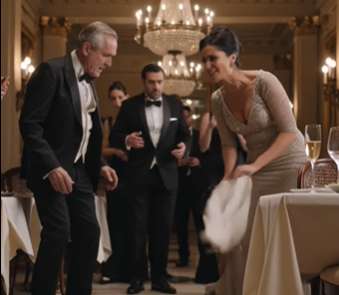
The chandeliers still shimmered overhead, candlelight still trembled across the rims of champagne glasses, and the violinist remained frozen beside a gold-trimmed pillar with his bow lowered at his side. But the entire room had changed. Only moments earlier, the scene had been horribly familiar in its cruelty: a rich woman shouting, a poor waitress crying, a public accusation launched with enough force that people mistook volume for proof. Now the necklace had faded into irrelevance. The old brass key in the maître d’s hand had opened something far more dangerous than a locked suite. It had opened memory.
The waitress remained on her knees, one hand pressed to the floor to keep herself from collapsing completely. Her cheeks were wet, her breath ragged, her apron torn. Yet beneath the panic, another expression was forming now — not understanding exactly, but the first terrible outline of it. The key had lived hidden in a velvet necklace box among her mother’s things for as long as she could remember. She had once asked what it opened, and her mother had answered only, “A room where rich people buried my name.” Years later, when illness made her voice thin and her body small, she pressed the box into her daughter’s hands and said, If anyone ever humiliates you over jewels, open nothing. Ask questions instead. At the time, it had sounded like bitterness. In the middle of that restaurant, it sounded like survival.
The maître d’ spoke with visible effort. He explained that twenty-one years earlier, before the current owner expanded the restaurant into one of Paris’s most exclusive addresses, the top private suite had served as a hidden residence for only the most intimate guests of one particular billionaire family. On one infamous night, the billionaire’s first bride entered that suite wearing a custom diamond necklace intended for a private celebration before their official wedding announcement. By morning, she was gone. The story given to staff was abrupt and cold: she had left in disgrace, the suite was to be sealed, the matter was to be forgotten. Staff were paid bonuses, non-disclosure agreements were signed, and anyone who kept asking questions was quietly dismissed.
The rich woman in the glittering gown tried to recover the room.
“This is absurd,” she said. “This girl is a waitress. She’s trying to attach herself to a story she doesn’t understand.”
But her voice no longer carried authority.
Because the room could hear the fear inside it.
The maître d’ turned toward her and asked softly whether she knew what the first bride’s necklace box looked like. The woman did not answer. She did not need to. The flicker across her face was enough. He said the box was velvet-lined, dark blue, with a hidden compartment beneath the silk base where the bride once kept a key “for the one place in Paris no one must open without me.” He remembered the phrase because she had laughed after saying it, and because by the end of that week she was gone.
The waitress closed her eyes for one second.
Her mother’s necklace box had been dark blue.
The older man stepped closer and studied her face again. He said the missing bride had not come from one of the old banking families the way the newspapers claimed. She had come from a quieter background, and that had always irritated the people who surrounded the billionaire. She was beautiful, yes, but too independent, too questioning, too difficult to shape into a decorative wife. There were whispers even then that she had found something in the suite — letters, account ledgers, proof of another relationship, something worth sealing a room over. Nobody knew which rumor was true. What mattered was that after that night, she vanished from polite society as if she had been cut out with surgical precision.
The waitress looked up and asked the question nobody else dared to ask.
“My mother’s name was Elina Varedo. Did you know her?”
The maître d’s hand tightened around the key.
“Yes,” he said. “But not as your mother.”
A murmur spread through the restaurant.
He explained that Elina Varedo was the seamstress and dresser assigned to help the first bride prepare on the night she disappeared. She was one of the last women seen entering that suite. Days later, she too vanished from staff records. Not dead. Not dismissed. Simply removed. He had always assumed she was paid off or threatened into silence. But if she had ended her life hiding the suite key inside the bride’s necklace box, then she had not disappeared to protect herself alone. She had disappeared carrying evidence.
The woman in the gown went visibly pale.
Because now the accusation downstairs looked far too fast to be innocent.
The maître d’ said there was more. The first bride had once told him, during a fitting for a private dinner, that if anything ever happened to her, the only honest witness in the room would be “the woman who buttons my dress.” That woman had been Elina. The seamstress. The waitress’s mother. Which meant the mother did not merely inherit the box by accident. She was entrusted with it. Trusted because she saw what others pretended not to see.
The whole restaurant began to understand at once why the rich woman had exploded over the missing necklace. Not because a jewel had vanished. But because a waitress carrying the wrong key, tied to the wrong box, tied to the wrong woman from the past, had entered the room at the exact moment another necklace became the excuse for public humiliation. That was too precise. Too loaded. Too unlucky to be simple chance.
The rich woman tried to interrupt again, insisting the story was fantasy, insisting the old man was confusing sentiment with fact. But the maître d’ barely looked at her now. He said the first bride’s necklace had never been publicly recovered. Officially, it disappeared with her. Yet the piece missing tonight was a redesign of that same setting — stones taken from the old necklace and reset years later, after the family tried to erase the original scandal. In other words, tonight’s jewel was not just expensive. It was historical. Symbolic. Dangerous. And the waitress’s mother had hidden the suite key inside its original box before she died.
The implication settled over the room like ash.
This wasn’t just a theft accusation.
It was an old family secret colliding with the daughter of the one woman who may have known what really happened.
The waitress slowly stood. She was still crying, still shaking, still humiliated before an entire room that had done nothing while she was dragged by the hair and forced to kneel. But she no longer looked merely small. Her face now carried something the guests found harder to stare at than tears: inherited truth.
The maître d’ then revealed the final detail. The sealed suite upstairs had never actually remained untouched. Once, twelve years earlier, someone used the key in the dead of night. Security logs were altered. No police were called. But one object was later missing from the internal inventory: a private ledger box kept inside the suite’s writing desk. If Elina had hidden the key inside the necklace box after that, then she likely knew the suite had been reopened and whatever mattered most had already been taken. The key was not just a key anymore. It was a warning passed to the next person who might survive long enough to ask why.
The woman in the gown took a slow step backward.
The room noticed.
Because now she looked less like a victim of theft and more like someone terrified the wrong daughter had walked into the right restaurant.
The waitress held the torn edge of her apron in one hand and looked at the woman who had humiliated her.
“You didn’t care about the necklace,” she said softly.
No one breathed.
She looked once at the brass key in the maître d’s hand, then back at the woman.
“You were afraid my mother left behind something your family never managed to bury.”