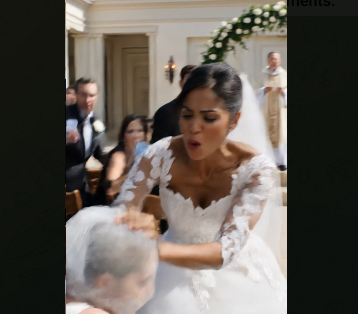
She was supposed to become his first bride — elegant, gentle, and deeply loved by him, even though his powerful family never truly accepted her. She was not wealthy enough, not connected enough, not the kind of woman they wanted standing beside their name.
But he chose her anyway.
Then, the night before the wedding, she disappeared.
The official story was simple: a tragic accident on the road to the chapel. Her car was found wrecked, a burned body inside, and the family announced that she was dead before dawn.
The wedding never happened.
The veil she was supposed to wear was buried with what everyone believed was her body.
No one questioned it.
No one except the woman’s closest maid — the mother of the crying woman now standing in the grass.
That maid had been the one who dressed the first bride in secret before the ceremony. She knew every stitch of the lace veil. She knew the bride had sewn a hidden note into its lining the night before, terrified that something would happen to her. It was a note meant only for the groom if she vanished.
But after the so-called accident, the veil was gone.
Years later, the maid discovered the truth.
The body in the car had not been the bride.
Someone had switched it.
The real bride had survived the attack and been hidden away, injured and silenced, because she had learned something she was never supposed to know: the groom’s family had arranged the “accident” after finding out she was pregnant.
The child would have changed inheritance, power, and the control of the family name forever.
Before she died years later, the maid confessed everything to her daughter and handed over the veil she had secretly kept all that time. She said there was only one moment the truth would matter enough to destroy the lie:
when he tried to marry again.
Now, standing in front of the altar, the groom’s hands were shaking because he remembered that handwriting. He had watched his first bride write notes exactly like that, looping her letters in the same delicate way.
But there was something worse.
The poor woman standing before him did not just resemble her mother.
She looked like the bride herself — the same eyes, the same mouth, the same expression when trying not to cry.
The priest took the veil, ran his fingers along the edge, and found another hidden stitch. Inside was a second folded scrap of paper, yellowed with age.
He opened it slowly.
This one was not addressed to the groom.
It was addressed to my daughter.
The crowd stopped breathing.
The bride stepped back in confusion, then horror.
The priest read the final line aloud:
“If you are old enough to carry this back to him, then they stole more than my wedding.”
The groom nearly collapsed.
Because in that instant he understood the truth.
The woman who disappeared before his first wedding had not died before becoming his wife.
She had lived long enough to give birth.
The crying stranger at his second wedding was not a messenger.
She was his daughter.
Then the poor woman looked at him through tears and said the line that shattered everything:
“My mother didn’t tell me to come here to stop your wedding.”
He stared at her, unable to speak.
And she finished:
“She told me to come because the woman who tried to kill her is the one standing in your dress.”