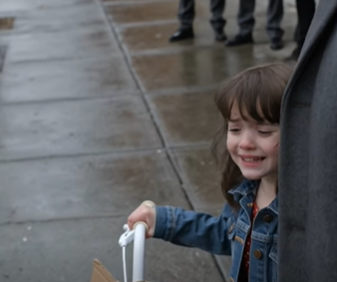
That was the first sign he understood exactly what kind of trouble was coming.
He stayed bent slightly toward the girl and asked, very quietly:
“Who told you not to come back?”
The child’s lips trembled.
She looked toward the wet pavement, not at him.
“My aunt,” she whispered. “She says Mommy is too weak to earn now.”
The suited man in the background kept walking closer.
The other three stayed where they were.
Watching.
The little girl’s fingers slipped on the handlebars.
“She said if I sold the bike,” the girl whispered, “maybe she’d let Mommy eat first.”
The man’s face hardened in a way the child probably did not understand, but every adult nearby would have.
This was no longer about hunger.
This was about control.
About someone starving one woman and using her child to finish the work.
The suited man stopped a few feet away.
“Everything okay here?” he asked.
Too smooth.
Too calm.
Too practiced.
The little girl flinched so slightly most people would have missed it.
The man in the grey coat did not.
He straightened slowly now and placed one hand on the bike seat, not possessively, but protectively — like he was quietly claiming the child’s side of the sidewalk before the conversation could be taken from her.
“She’s fine,” he said.
The suited man smiled without warmth.
“She’s with family.”
The little girl whispered, almost soundlessly:
“No.”
That one word changed everything.
The man in the coat looked down at her.
The girl’s eyes were full of terror now, not sadness.
“She’s not family,” she whispered. “She just moved in after Daddy died.”
The suited man’s smile disappeared.
The three others by the store entrance shifted.
The man in grey understood at once.
Dead father.
Hungry mother.
Sudden “aunt.”
Child selling the house piece by piece.
Four silent men making sure nobody interrupted.
He reached into his coat pocket slowly.
The suited man tensed.
But instead of a wallet, the man pulled out an ID wallet and flipped it open just enough for the other man to see.
Whatever was inside made the suited man’s face change instantly.
Not fear.
Recognition.
Because this was no ordinary passerby.
The little girl looked up, confused.
The man in grey kept his eyes on the suited man and said, calm as winter:
“You should have left before she asked me to buy the bike.”
The little girl blinked through tears.
Because for the first time since he stopped in front of her, she understood something huge:
He had never really been deciding whether to buy the bicycle.
He had been deciding how many of them were watching.