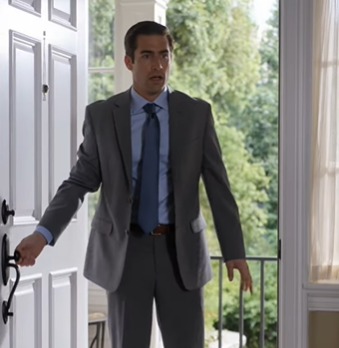
The man stared at the cracked frame in his hand.
Then at the woman in blue.
Then back at the little girl trembling in his arms.
His voice came out barely above a whisper.
“What did she say?”
The child clung to his jacket.
“She got mad because I asked why the lady in the picture looks like me,” she sobbed.
“She said she was nobody. Then she dropped the juice and told me to scrub until her face was gone.”
The man slowly stood, still holding his daughter with one arm, the broken frame in the other.
His wife finally set down the glass.
“You’re upsetting her,” she said coolly.
But now he was really looking at the photo.
At the date in the corner.
At the house behind them.
At the woman’s face.
And then memory hit him like something ripping open.
Not a full memory.
Fragments.
A hospital corridor.
A funeral in the rain.
A doctor saying he was too sedated to stand.
Papers he signed while half-conscious.
A child crying somewhere nearby.
He looked at his wife again.
Only now, she looked less composed.
Because she could see it happening.
He was remembering.
“You told me she died,” he said.
The woman in blue went pale.
The little girl pulled back just enough to look at his face.
“Who died?” she whispered.
No one answered her.
The man’s hand tightened around the broken frame.
Then he turned it over.
And found writing on the back in his own handwriting:
For Elena and our daughter — first day home.
The room went dead silent.
The child’s eyes widened.
Because her name was Elena too.
The woman in blue took one step back.
“That was before—”
“Before what?” he snapped.
For the first time, she had no cold answer ready.
Only fear.
Because now he understood what the child had been forced to clean.
Not a random mess.
Not an accident.
A photograph.
Evidence.
Memory.
A life someone had tried to erase from the walls of his own home.
Then the little girl, through tears, asked the question neither adult wanted her to ask:
“If that lady is my real mommy… why did you tell me she abandoned me?”
The woman in blue shut her eyes.
Too late.
The man’s expression changed completely.
No more confusion.
No more shock.
Only the sick certainty that a lie had been living in his house for years.
He took his daughter’s hand.
Moved her behind him.
Then looked at the woman in blue and said quietly:
“Start talking before I call the police and dig up every paper from the year my memory disappeared.”
And the way her face collapsed told him something even worse:
the truth was already buried in documents someone had helped rewrite.
The end.