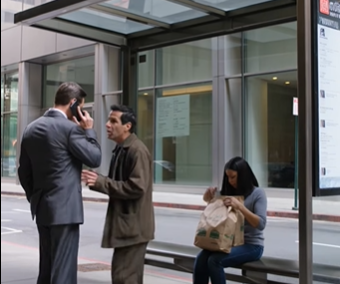
The woman holding the grocery bags stared at him, her phone still half-raised in her hand, while the businessman and the other woman suddenly looked like people who wanted to disappear without moving.
The old man closed the briefcase slowly.
“My daughter was twenty-four,” he said. “She had asthma, a weak heart, and too much faith in strangers.”
His voice never rose.
That made it worse.
“She missed her ride that night. Her phone was dead. She asked three people at this stop if she could make one call.”
The woman in the patterned dress covered her mouth.
The businessman went pale.
Because now neither of them wanted to ask the next question.
But the kind woman whispered it anyway.
“What happened?”
The old man looked down at his prosthetic leg for a second, then back up.
“She collapsed two streets away before she reached help.”
No one spoke.
The man in sunglasses beside him lowered his eyes respectfully, as if he had heard the story before and still hadn’t found a way to stand comfortably inside it.
The old man continued.
“I built a logistics company from nothing. Sold it last year for more money than my family could spend in three lifetimes. But none of it mattered the night my daughter died because no one at a bus stop thought one phone call was worth the risk.”
The kind woman’s grip tightened on the grocery bags.
The rude woman was crying now, but quietly, like someone ashamed to let grief sound too much like guilt.
The businessman finally found his voice. “Sir… I didn’t know.”
The old man looked at him calmly.
“That’s exactly the problem,” he said. “You decided you didn’t need to.”
Then he turned back to the woman on the bench and placed the gold briefcase at her feet.
Inside, beneath the cash, were also documents.
A lease agreement.
A job offer.
A medical insurance packet.
And one envelope with her name written neatly across it.
She stared in disbelief. “What is this?”
“A new apartment,” he said. “A job at one of my foundation offices, if you want it. And enough money to make sure kindness never leaves your children hungry.”
Her eyes overflowed now.
“Why me?”
He looked around the bus stop one last time.
“Because grief taught me something ugly,” he said. “Most people don’t fail big tests. They fail tiny ones.”
The woman began to cry openly.
Then he reached into his coat and pulled out a small photograph.
A young woman smiling beside a bus stop, holding an inhaler in one hand.
He showed it only to her.
“She looked like the kind of person you would have helped too.”
The woman touched the photo with trembling fingers.
And that was when the businessman in gray whispered, horrified:
“Oh God…”
Because he recognized the face.
Not from the news.
Not from a poster.
From his office.
She had been the intern he fired six months earlier after she missed work twice for “medical excuses.”
The old man heard him.
And slowly turned.
“You knew her,” he said.
The man’s lips trembled.
The old man’s expression changed again — not into rage, but into something colder.
Because now he understood this had never been just one missed phone call.
It was a whole chain of people deciding his daughter was inconvenient.