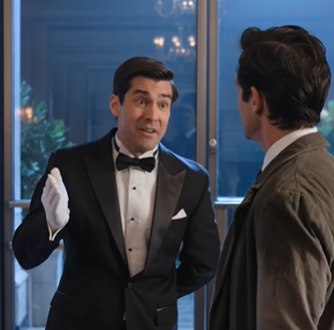
The waiter looked like he might collapse. The security guard kept his eyes on the floor. Even the diners who had been pretending this was just awkward entertainment now understood they were sitting inside someone else’s reckoning.
The man in the blue suit stood perfectly still beneath the chandeliers, briefcase in one hand, years of buried anger held under frightening control.
“I asked for one thing,” he said. “A name.”
No one answered.
Then, from the back of the room, the oldest diner at the corner table began to rise.
Slowly.
Painfully.
His hands trembled before his voice did.
“It was me.”
A ripple moved through the restaurant.
The waiter turned in shock. The manager near the bar went white. Because the old man was not some forgotten guest.
He was the founder.
The one whose portrait hung in the entrance lobby. The one every employee was told to revere. The man who built the restaurant’s reputation on elegance, discipline, and “standards.”
The suited man stared at him without blinking.
The founder swallowed hard. “I told them to remove her,” he said quietly. “I thought she was begging. I thought she was drunk. I never knew she was sick.”
The room felt smaller now.
Tighter.
The younger man’s jaw tightened. “She asked for water.”
The founder closed his eyes.
“I know.”
The chandeliers reflected in the polished floor between them like broken glass.
“My mother cleaned offices across the street,” the younger man said. “She had a fever. She collapsed outside after your staff shoved her into the storm. By morning, she was gone.”
A woman at a nearby table covered her mouth.
The founder looked older with every word.
“I tried to find you,” he whispered.
The younger man gave a cold, hollow smile. “No. You tried to forget her.”
That landed harder than any shout.
Then he opened the briefcase again — but this time not to show money.
Under the stacks of cash was a folder.
Inside were purchase contracts, ownership papers, and one final document: a closure order for the restaurant’s current operating company.
Gasps broke out across the room.
“You bought it?” the manager whispered.
“No,” the man said. “I bought the whole block.”
He let that settle for one brutal second.
“By midnight, every employee who treated poor people like dirt is finished here.”
The waiter nearly begged. “Sir, please—I didn’t know—”
“That’s the problem,” the man said, turning toward him at last. “None of you think you need to know who someone is before deciding what they deserve.”
Silence again.
Heavy. Final.
Then the founder took one shaky step forward.
“What do you want from me?”
The younger man looked at him for a long moment.
Not with pity.
Not even really with hatred anymore.
Just with the emptiness of someone who had waited too long for justice to still feel clean.
Then he said:
“I came here tonight to ruin what you built.”
He paused.
“But after I walked in…”
His eyes moved across the dining room.
“…I realized something worse.”
The founder frowned.
The younger man pulled one last paper from the folder and held it up.
A DNA report.
The founder’s face drained of all color before anyone else could understand why.
Because suddenly this was no longer only about the mother who died at the door.
It was about what happened before that.
And the younger man delivered the final blow in a voice barely above a whisper:
“She wasn’t just your victim.”
He looked the old man straight in the eyes.
“She was your daughter too.”