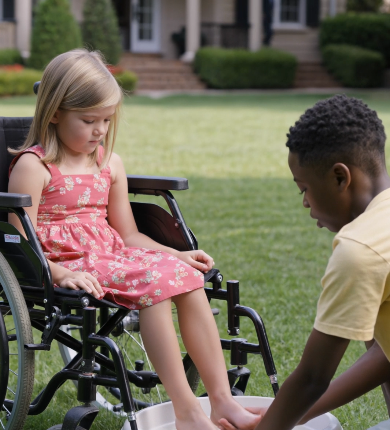
For one long second, nobody moved.
The girl gripped the arms of her wheelchair, staring at him with tears already building in her eyes.
“What did he mean?” she asked.
Her father shook his head too fast. “He’s lying. He’s just a kid.”
But the boy didn’t back down.
He stepped closer and pointed at the wheelchair. “Ask him why he never let the doctors from the city examine you. Ask him why only one doctor ever came to this house. Ask him why your medicine always made you sleep.”
The girl’s face changed.
Not because she understood everything.
Because part of her already did.
Memories were starting to come back now — broken ones, sharp ones.
The balcony.
The shouting.
Her mother crying.
Her father’s hand reaching too fast.
The fall.
The official story had always been simple: she slipped by the garden steps and damaged her spine.
But that wasn’t the story she had woken up screaming from in the middle of the night.
She turned to her father, voice shaking. “Mom was there that day.”
He said nothing.
The boy swallowed hard and finally revealed why he knew so much.
His mother had worked in the house for six years. On the night of the “accident,” she had heard the father threatening the family doctor. Weeks later, before disappearing from the job forever, she hid copies of the medical files and told her son one thing:
When the girl is ready, help her remember.
The boy had waited.
Watched from a distance.
Listened.
Brought the one thing his mother said might break the fear in her body: warm water, touch, and the truth said out loud.
Because the girl had never been fully paralyzed.
She had been traumatized, heavily sedated, and kept terrified enough to believe she could never stand again.
Why?
Because as long as she stayed weak and dependent, she could never testify about what really happened the day her mother died.
The father took one step back.
That’s when the girl did the impossible.
Still shaking, still crying, she pushed both hands into the sides of the wheelchair and lifted herself halfway up.
Not fully.
Not steadily.
But enough.
Enough to destroy his lie forever.
He looked at her like a man watching his own future collapse.
“Sweetheart,” he started, “please, let me explain—”
“No,” she whispered.
Then she looked at the boy, reached for his shoulder, and with trembling legs forced herself up just a little more.
By the time the house staff came running and the first phone call to police was made, she was still standing there, barely, with tears streaming down her face.
Not because she was healed.
Because she finally knew she had never been broken the way he wanted her to believe.
And when officers later asked the boy why he risked everything for a girl from a house that never noticed him, he looked at the overturned basin in the grass and answered:
“She didn’t need someone to carry her.
She needed someone to wash away the lie.”