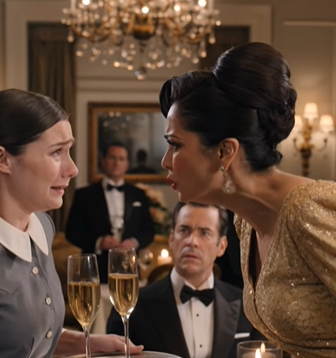
For one long second, the candles seemed too bright.
The woman in gold stood frozen beside the table, one hand pressed to her chest, the shimmer of her dress suddenly looking cheap against the weight of what had just been said.
The man in the tuxedo stared at the baby photo.
Then at the waitress.
Then slowly at his wife.
Because years ago, the story had been simple.
Complications during birth.
A child who did not survive.
A funeral too painful to witness.
A wife who wept and handled everything so he wouldn’t have to.
He had believed it because grief makes lies easier to swallow when they come from the person holding your hand.
But the blanket in the photo was real.
The stitching was real.
And worst of all—
the face of the young waitress standing in front of him carried something painfully familiar.
His eyes.
His mother’s mouth.
A daughter’s age.
The waitress swallowed hard.
“My mother was the night nurse,” she whispered.
“She fell in love with the wrong baby.”
The room broke on that sentence.
Guests looked at one another.
Glasses stopped halfway to lips.
No one could decide whether to leave or stay and witness the ruin.
The woman in gold tried to speak.
“She’s lying.”
But her voice shook.
Not with outrage.
With panic.
The waitress reached into her apron one last time and pulled out a folded hospital band.
Yellowed with age.
Preserved carefully.
On it was the baby’s last name.
His last name.
And a birth time matching the night his child was supposed to have died.
The man rose from the table slowly.
Not because he was angry yet.
Because rage had not even caught up to the grief.
“You told me she was dead,” he said to his wife.
The woman in gold stepped back.
Because now everyone understood what had really happened.
She had not buried a child.
She had buried a story.
A husband’s heir.
A rival mother.
A truth too dangerous to let live inside the life she wanted.
The waitress’s voice broke as she spoke again:
“My mother raised me until she died.
Then she made me promise… if I ever found you, I would bring the picture first.”
The man looked at her like he was trying to count twenty-two stolen years in a single breath.
Then the waitress said the line that shattered what was left of him:
“She said you cried when they took me.”
And suddenly the elegant dining room was no longer a place for polished smiles and candlelit lies.
It was a courtroom.
And the waitress in gray was not there to serve champagne.
She was there to return the daughter
his wife had paid to erase.