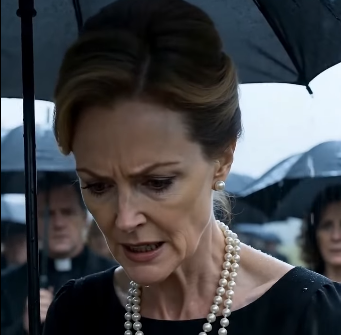
For one long second, the whole funeral entrance stood still in the rain.
No one moved to fix the widow’s umbrella.
No one stepped in front of the boy.
No one dared speak over the dead man’s last words still hanging in the air.
Because suddenly this was no longer a funeral.
It was a reckoning.
The widow stared at the child as if the life she had carefully arranged was cracking open right there on the church steps.
Years earlier, before the wealth was fully his and before the marriage became a transaction built on appearances, the dead man had loved control more than honesty. He bought properties, moved money, built quiet rooms where different versions of himself could exist without touching each other.
One of those versions was the apartment.
And in that apartment, a cleaning woman became someone he thought he could keep hidden the way he hid everything else.
When she became pregnant, he paid for silence.
Not cruelty, exactly.
Cowardice dressed as generosity.
But the woman did not disappear.
She raised the boy alone.
And sometime in the last year, when illness or guilt finally stripped away his pride, the man found them again.
Too late to become a father.
Just early enough to leave a message.
The widow looked at the phone in her hand.
Then at the boy.
Then back toward the church doors, where the coffin waited behind flowers and polished lies.
Her voice was brittle now.
“How old are you?”
The child answered.
And the number made several guests look away, because it matched the exact year the dead man made his largest unexplained withdrawal from a private account no one in the family had ever been allowed to question.
The widow’s face changed again.
Because now she understood something even worse:
he had not hidden the boy from shame.
He had hidden him from inheritance.
If the child had been acknowledged, the estate would split.
Trusts would reopen.
Names on paper would shift.
The boy hugged himself tighter against the cold.
“My mom said he came back when she got sick.”
A pause.
“He brought food. Then he cried.”
That hit harder than accusation ever could.
Because it meant the dead man had known exactly what he had done.
The widow whispered, almost to herself:
“He left me everything.”
The boy shook his head.
“No.”
Then he pointed to the phone.
“He said he left me proof.”
That was when the final part of the voice note began playing again from the cracked speaker, loud enough for the nearest mourners to hear:
“The bank envelope is in the blue safe.
Half is his.”
The widow closed her eyes.
Not because she doubted it.
Because she believed it immediately.
And the guests, standing under black umbrellas in the rain, finally understood that the soaked child on the steps had not come to ruin a funeral.
He came because the dead man had arranged one final betrayal:
to tell the truth only after he could not be forced to deny it.
And suddenly the widow was not just a grieving wife.
She was the woman who had to decide whether to bury the man honestly—
or bury his son one more time.