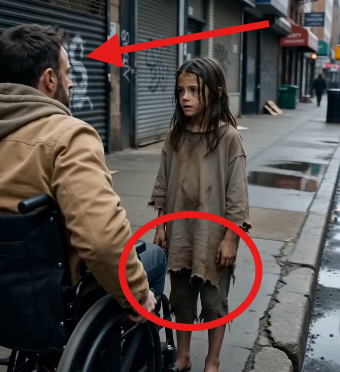
Elias gripped the wheels of his chair so hard his palms burned.
The alley seemed to darken around the sound of her voice.
Not because it was frightening.
Because it was impossible.
After thirteen years of silence, guilt, and self-punishment, there it was — Mara, alive just a few yards away, hidden behind a row of shuttered shops and broken crates like the city had swallowed her and decided not to spit her back out until now.
The girl — Lina — turned toward the alley.
“He stopped,” she called softly.
A long pause followed.
Then a cough.
Then the scrape of someone trying to stand.
Elias pushed the wheels forward without thinking. The chair bumped off the curb, jolted through a shallow puddle, and stopped at the mouth of the alley.
She was there.
Wrapped in old blankets near a stained brick wall.
Thinner than memory had any right to allow. Older, of course. Hollow-cheeked and pale from hunger, with a cough that shook her whole body. But it was Mara. The same eyes. The same mouth. The same woman he had once sworn he would come back for before fear turned his promise into rot.
For a second, neither of them spoke.
Then Mara looked at the wheelchair.
Her eyes closed.
“So it found you too,” she whispered.
Elias felt those words like a knife.
The chair.
The punishment.
The price.
Three years after he abandoned Winter Street, the men he owed finally caught him. He survived the beating. His legs did not. Since then he had lived as if suffering were justice, as if pain itself might someday balance the debt he had left behind.
It never had.
Now he saw the truth.
He had not suffered alone.
Lina stood between them, still holding the ring.
“She wanted to know if you’d tell the truth,” Mara said.
Elias looked at his daughter.
Then at the ring.
Then back at Mara.
His throat tightened so badly he had to force the words out.
“My name is Elias Vane,” he said. “And I am her father.”
Lina’s face changed instantly.
Not into joy.
Into relief so sharp it looked like it hurt.
Mara began to cry quietly.
Elias had imagined this moment a thousand different ways over the years. In every version, he explained himself better. In every version, he was less ashamed. In every version, he arrived sooner.
Reality gave him none of that mercy.
“I came back too late,” he said.
Mara laughed once through tears.
“Yes.”
He took the blow because he deserved it.
Then he asked the only question that mattered now.
“Why did you send her to me?”
Mara’s hand rose weakly to her chest.
“Because you were the only door left.”
Lina slowly placed the ring in his hand.
It felt colder than it should have.
Mara watched him hold it and seemed to gather the last of her strength around a decision she had already made.
“Your father came once,” she said.
Elias looked up sharply.
“What?”
“Years ago. After the first baby died.” Her voice trembled. “He found us here. He said your family had a blood disorder. Rare, dangerous. He said if one of your children ever got sick, only a direct blood relative from your line might match what they needed.” She looked at Lina. “I thought it was another cruel story from rich people. But last month the clinic tested her.”
Elias went still.
Lina was watching both of them now, silent and serious.
Mara swallowed hard.
“She’s sick.”
The world narrowed instantly.
No noise from the street. No wind. No traffic. Nothing.
Just those two words.
“What kind of sick?” he asked, but he already hated the fear in his own voice.
Mara reached into the blanket beside her and pulled out a folded clinic paper, worn at the edges from too much handling. Elias took it with shaking hands.
He didn’t understand all of it.
He understood enough.
Blood markers.
Urgent treatment.
Family match required.
He looked at Lina.
At her thin wrists.
Her tired eyes.
The calmness that was never calm at all — only exhaustion dressed as bravery.
“She said your blood could heal my legs,” he whispered.
Mara nodded once.
“She’s ten,” Mara said. “She thought miracles were easier to explain than bone marrow.”
That broke him more completely than anything else.
Lina lowered her eyes for the first time.
“I didn’t know how to make you stop,” she said. “You looked like a man who wouldn’t listen unless the story sounded magical.”
Elias let out a broken sound that might once have been a laugh.
Then he started crying.
Not politely.
Not like a man used to controlling rooms.
Like someone who had finally reached the exact center of his failure and found his child standing there waiting.
He rolled toward Lina and held out both arms slowly, giving her room to refuse.
She didn’t.
She stepped into them at once.
He pulled her against his chest, and she clung to him with the quiet desperation of a child who had spent too many nights not knowing whether this moment would ever come.
“I’m sorry,” he whispered into her hair. “I’m sorry for Winter Street. I’m sorry for every day after it.”
Lina’s voice came small against his shoulder.
“Can you still help me?”
He pulled back just enough to look at her.
“Yes.”
No hesitation.
No fear.
Just yes.
Then he looked at Mara.
“We’re getting out of here.”
She gave the faintest shake of her head. “I can’t walk far.”
Elias wiped his face roughly, then turned the wheelchair slightly.
“Then you take the chair.”
Mara stared at him.
He touched the wheel once.
“I should have come back with my legs,” he said. “I came back with this instead.” His eyes filled again. “It’s enough.”
For one second, Mara only looked at him.
Then, despite the sickness and the years and the ruin between them, she smiled the tiniest, saddest smile.
It was not forgiveness.
Not yet.
But it was a door opening.
In the distance, a siren drifted somewhere through the gray city.
Elias pulled out his phone with shaking hands and called the one private clinic he had avoided for years because it carried his family name on the building.
When the receptionist answered, his voice turned hard and steady in a way it had not sounded in a decade.
“My name is Elias Vane,” he said. “Prepare blood matching now. For my daughter.”
Then he looked back at Lina.
No more myths.
No more running.
No more Winter Street.
Just the truth, finally doing what it should have done years ago:
coming back for her.