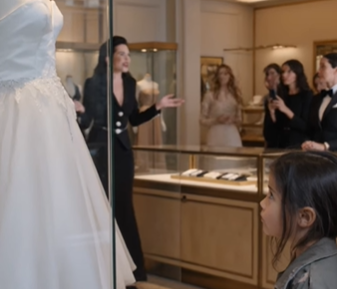
Even the woman filming lowered her phone without realizing it.
The elderly seamstress moved toward the little girl as if pulled by something older than reason, older than fear.
Her trembling fingers hovered over the scarf.
“What is your name?” she asked softly.
The child swallowed.
“My mother told me not to say it,” she whispered, “unless someone recognized the stitching.”
A gasp escaped one of the saleswomen.
The seamstress closed her eyes for a brief second, trying not to break.
Years ago, she had hand-embroidered that same name into a tiny white blanket and a matching christening dress for a wealthy family’s newborn daughter. But before the baby could ever wear them, the family announced the child had died at birth. The nursery was closed. The clothes were packed away. No questions were allowed.
And now here stood a little girl wearing that name in threadbare stitches on an old scarf.
The seamstress looked toward the white dress in the window.
“That dress…” she whispered, “was ordered every year on this date. Same size changed, year after year. Paid for, but never collected.”
The rich fashionable woman went pale.
“That proves nothing,” she said too quickly.
But the seamstress was already kneeling in front of the child.
“Did your mother leave you anything else?”
The little girl nodded.
From inside her torn coat, she pulled out a folded piece of fabric wrapped in paper.
The seamstress opened it with shaking hands.
Inside was a tiny white ribbon, yellowed with age.
On it, embroidered in gold thread, were the words:
“For my daughter, on the day they return her to me.”
The boutique seemed to stop breathing.
The seamstress stared at the ribbon, then slowly turned it over.
On the back was the family crest.
The same crest used by the boutique’s wealthiest client.
The same family that had claimed the baby died.
Now all eyes turned toward the rich woman.
Because everyone in the room suddenly remembered—
she wasn’t just a customer.
She was the aunt who had always come alone to place the yearly order.
The little girl looked around in fear.
“My mother said,” she whispered, “if the lady got scared before anyone hugged me… then she was part of why I was lost.”
The seamstress rose slowly, horrified.
The rich woman backed away, her face drained of color.
And just then, the boutique door opened.
A distinguished gray-haired man stepped inside, removing his gloves, asking if the annual dress order was ready.
The seamstress looked at him with tears in her eyes.
Then at the little girl.
And the man followed her gaze to the child’s face—
before dropping the receipt from his hand.
Because he was looking at the daughter he had been told was buried years ago.