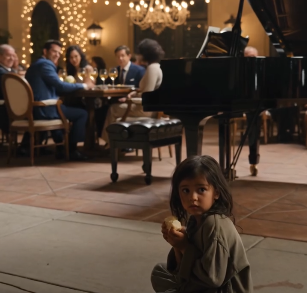
The guests heard scandal.
The man in blue heard insult.
But the man standing by the piano heard memory.
He looked at the little girl’s face properly now — not the dirt, not the torn sleeves, not the public tragedy of her sitting on the sidewalk for scraps.
Her face.
And something in his own collapsed.
“Who are you?” he asked.
Wrong question.
Because if he had truly not known, he would have sounded confused.
Instead, he sounded afraid of already knowing.
The little girl’s hands stayed on the keys.
She pressed one more note softly, almost absentmindedly.
It echoed through the string lights and expensive silence.
“My mother used to make me play that part slower,” she whispered. “You said fast hands hide sad hearts.”
The man went white.
Now even the nearest guests could feel this was no strange child with a talent.
This was history walking barefoot into a courtyard that had tried to eat it alive.
The blue-suited man looked between them. “What is this?”
No one answered him.
The little girl stared at the standing man with tears slipping down both cheeks now.
“She waited for you,” she said. “Even after the letters stopped.”
The man’s mouth parted, but no defense came out.
That silence was its own confession.
The woman at the nearest table leaned forward. The waiters had stopped moving. Even the pianist’s bench seemed to belong to someone else now — someone richer than anyone there, because memory was outranking money in real time.
The man finally found his voice.
“I thought you were dead.”
The little girl flinched.
Not because she believed him.
Because she had heard that line before.
“My mother said that too,” she whispered. “Right before she died.”
The whole courtyard changed temperature.
The man staggered one step closer.
The blue-suited mocker no longer looked entertained. Now he looked like someone who had accidentally lit a match in the wrong room.
The child’s fingers slid off the keys and into her lap.
“She kept your picture in the piano bench we sold,” she said. “The one with your name inside.”
The man closed his eyes for one second.
That detail was too private to survive denial.
When he opened them, the years between then and now had vanished from his face, leaving only guilt and a kind of disbelief so raw it looked almost childish.
“I searched for you,” he said.
The girl shook her head.
“No,” she whispered. “You searched where rich people lose things.”
A beat.
“We were lost where poor people disappear.”
Now nobody in the courtyard breathed normally.
Then the man in black looked at her again — at the eyes, the hands, the melody she had carried, the accusation she had earned —
and asked the question that made the whole scene hurt even more:
“Does she know I came back?”
The little girl’s face broke completely.
And in a voice barely louder than the fading piano note, she said:
“She died still saving your chair at the table.”