Denial.
Confusion.
Maybe even panic.
What he had not expected was silence so guilty it felt rehearsed.
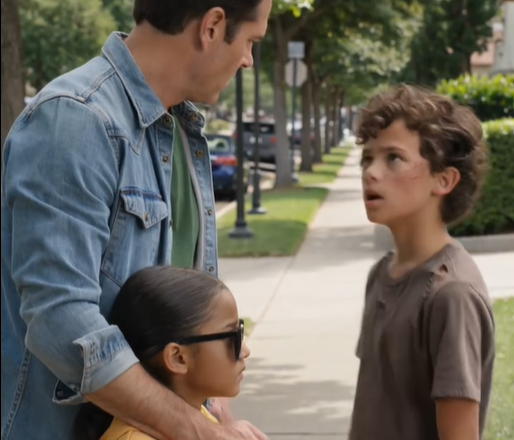
He knelt in front of his daughter on the sidewalk, trying to steady his own voice before he spoke.
“Look at me,” he said softly.
She didn’t.
Of course she didn’t.
That had been the whole point for months.
His throat tightened.
“What do you see when you hear her name?”
The girl’s fingers clenched so hard around the white cane her knuckles went pale.
The boy still hadn’t moved.
He stood a few feet away in the sun, dirty and scraped and terrifyingly calm, like someone who had already watched this exact moment happen in his head before risking it for real.
The girl’s mouth trembled.
Then she whispered:
“The stairs.”
The father went cold.
Not because he understood.
Because she had answered too quickly.
Too specifically.
“What stairs?” he asked.
Tears started sliding down under the edge of her sunglasses.
“The back stairs,” she whispered. “When she said if I kept looking at you, I’d fall again.”
The father stopped breathing for a second.
The boy finally spoke again.
“I heard her,” he said. “At the rehab place behind the church. She told the nurse the girl only stopped trying after the fall.”
The father turned toward him sharply.
The boy swallowed once, but held his ground.
“She said blindness was easier,” he said. “Because blind children don’t describe what they saw.”
Now the sidewalk felt too bright.
Too open.
Too normal for what was happening in it.
The father looked back at his daughter, really looked this time — at the fear, the tension in her jaw, the way she had been performing helplessness while carrying something too large for a child to keep buried.
“What did you see?” he asked.
The girl began to cry soundlessly.
Then, in a voice so small it barely survived the air, she said:
“She pushed my mother first.”
The boy’s face didn’t change.
He already knew.
The father’s did.
Everything in him seemed to freeze around that one sentence.
Not blindness.
Not illness.
Not a misunderstanding inside a broken family.
Witness.
That was what his daughter had become.
And suddenly he understood why someone might prefer a child who could not see.
Not because she was weak.
Because she was dangerous.