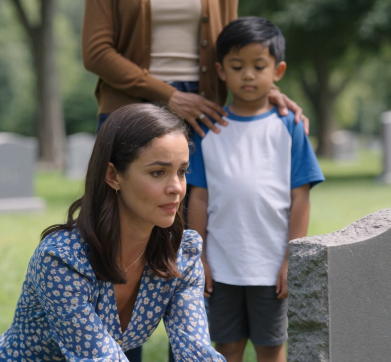
Because in the photograph on the headstone, one of the girls had always been smiling wider than the other. Everyone else saw twins. Or sisters. Or tragedy.
A mother sees differences strangers never learn.
And the boy had just seen one too.
The woman in the brown cardigan stepped forward quickly.
“I’m so sorry,” she said. “He says things without—”
“Please,” the grieving mother whispered. “Please don’t stop him.”
That silenced all three of them.
The boy looked again at the picture, more carefully now, like he was trying to understand why adults suddenly looked as if the grave itself had spoken back.
“They sit near the art shelf,” he said. “Not together always. But they talk like sisters.”
The woman in blue pressed one hand to her mouth.
No.
That wasn’t possible.
She had buried them.
Or at least she had buried what the hospital, the police, the priest, and every official paper had told her were her daughters.
The woman in the cardigan glanced between the photo and the grieving mother with growing alarm.
“What are their names?” the grieving woman asked.
The boy answered too easily.
“Eva and Lila.”
The lilies slipped from the woman’s hand.
Because those were not random names.
Those were the names written on the back of the only hospital bracelet she had kept hidden after the funeral.
The cemetery air changed.
Not louder.
Worse.
Sharper.
The woman in blue looked at the framed photo again — two girls frozen forever in smiles — and suddenly the thing that had always felt strange about that picture came back in full force.
The hair lengths had been wrong.
One ear had been hidden.
The dresses had not been the ones she packed.
She had been too broken then to fight details.
Now every detail returned like a wound waking up.
The boy kept talking, because children do not know when adults are collapsing in front of them.
“One girl told the teacher she used to have different names,” he said. “But then the other girl squeezed her hand.”
The woman in blue made a broken sound in her throat.
The cardiganed woman went pale.
Now this wasn’t a misunderstanding.
Not a child inventing things.
Not grief hearing what it wanted.
This was pattern.
Silence.
Training.
The grieving mother stepped closer to the boy, not touching him, afraid even now that hope might vanish if she moved too suddenly.
“What school?” she asked.
The boy frowned. “St. Martha’s.”
That hit like a hammer.
Because St. Martha’s sat less than twenty minutes from the hospital where the girls had been declared dead.
The woman in blue’s whole face emptied.
Then the little boy said the one sentence that turned mourning into horror:
“One of them asked me if moms still visit graves when the kids inside aren’t really there.”