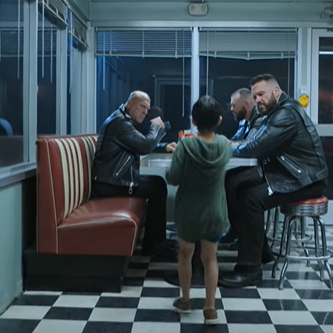
The boy started crying again, quieter this time, like he was too tired to be scared properly anymore.
“She isn’t dead,” he whispered. “He keeps her somewhere. She told me to run when he fell asleep.”
Nobody in that diner spoke.
Rooster kept staring at the photograph like it had reached out of the past and grabbed him by the throat.
The woman in the picture was his younger sister, Mae.
Seven years earlier, everyone in town had been told she overdosed and disappeared somewhere off the highway.
No body.
No funeral.
Just rumors and silence.
Rooster had never believed it.
Now a child with Mae’s eyes was standing in front of him, wearing a torn hoodie, trembling in the middle of a roadside diner, while a black car waited outside.
The driver stepped out.
Long dark coat.
Clean shoes.
No hurry.
That’s what made him worse.
Men who panic can be fought.
Men who walk slowly usually think they own the ending.
One of the bikers moved toward the door, but Rooster lifted a hand. “Not yet.”
He crouched in front of the boy. “What’s your name?”
The child swallowed hard.
“Eli.”
Rooster nodded once. “Did your mom say who was driving that car?”
Eli’s lips trembled.
Then he whispered a name that made the waitress drop a plate in the kitchen.
It was Judge Harlan Voss.
The same man who’d been on television for years talking about child protection, shelters, and missing kids.
The same man half the town called a hero.
Rooster stood up so fast his stool hit the floor.
Outside, Judge Voss was already halfway to the diner door.
Eli clutched Rooster’s hand and whispered,
“He said nobody would ever believe a dirty kid over him.”
Rooster looked down at him, then at the door, then back at the photograph.
When the bell above the diner door rang and the judge stepped inside smiling like nothing was wrong, Rooster didn’t throw the first punch.
He did something worse.
He placed the photograph on the counter where everyone could see it, turned to the whole diner, and said loud enough for every booth to hear:
“You all know this man. So before he lies, look at this boy’s face… and tell me whose eyes he has.”
The diner went silent.
The judge’s smile disappeared.
And from the kitchen, the old waitress came forward shaking, staring at Eli with tears in her eyes.
“I know that child,” she whispered.
“I held him the night Mae gave birth.”
Then she pointed straight at the judge and said:
“You told us the baby died.”