That’s how I knew he remembered her.
My mother.
Angela Brooks.
A public defender who spent half her life fighting for people no one else cared about. Six years earlier, she had been arrested during a late-night traffic stop when officers claimed they found drugs in her car. Her career collapsed in forty-eight hours. Her clients vanished. Her name was dragged through the dirt on every local channel.
Three months later, she was dead.
Officially, it was called stress, pills, and heartbreak.
Unofficially, it was what happens when the system crushes the wrong woman and expects her family to disappear quietly.
But my mother left me something before she died:
a locked box full of notes, names, badge numbers, dates, and one sentence written across the top of the first page:
They do this to people who can’t fight back. Make sure someone does.
So I did.
I became a federal civil rights investigator.
And for eleven months, I built a case around traffic stops, missing body-cam footage, falsified evidence logs, and a pattern nobody in that department thought anyone could prove.
Tonight was never random.
The broken taillight was fake.
The stop was planned.
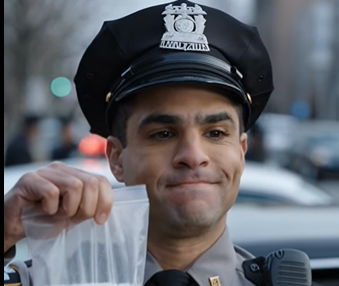
And the bag in his hand was the last piece I needed.
Because the hidden camera under my dashboard wasn’t the only thing recording.
The police cruiser behind us was wired too.
Not by them.
By us.
I watched him realize it all at once.
The camera.
The photo.
The name Brooks.
The fact that I was standing there absolutely calm while he was the one sweating.
His radio crackled.
Then another car pulled up behind the cruiser.
Then another.
No sirens.
No rush.
Just the slow, terrible arrival of consequences.
He glanced toward the backup, desperate now. “You set me up.”
I shook my head.
“No,” I said. “You tried to frame me. I just gave you room to do what you’ve always done.”
Two plainclothes agents stepped out.
The officer’s partner, the one who had stayed near the cruiser pretending not to watch, suddenly started moving backward.
One of the agents called out, “Nobody moves.”
The officer still had the bag in his hand.
Still wearing gloves.
Still caught in the exact little performance he had probably done a dozen times before.
I took one more step toward him.
“You should know something,” I said quietly. “My mother begged the last officer to believe her too.”
His jaw tightened. “I didn’t touch your mother.”
I held up the photograph again.
“No,” I said. “You just watched.”
And sometimes that’s worse.
When they put him in handcuffs, he finally looked afraid—not of prison, not of losing his badge, but of the truth becoming public.
Because corruption loves darkness.
And that night, under flashing red and blue lights, every ugly thing he had hidden was standing in daylight.
One of the younger officers nearby stared at me and asked in disbelief, “You planned this whole stop?”
I looked at the black car, the planted evidence, the trembling man in cuffs, and thought of my mother’s ruined name.
Then I answered the only way that felt honest:
“I planned nothing. I just knew a guilty man would reach for the same bag twice.”