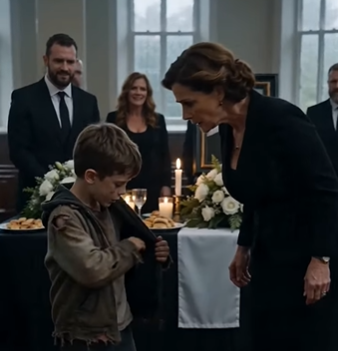
The sound of breaking glass seemed to hang in the church hall longer than it should have.
Nobody moved.
Not the guests.
Not the widow.
Not even the teen son beside her.
Because suddenly this was no longer a funeral reception.
It was a reckoning.
The boy stood there holding the birthday card like it was the only thing keeping him upright.
And in a way, it was.
Years earlier, before the polished family image, before the black mourning dress and the carefully arranged sympathy, the dead man had another life. A hidden apartment. A hidden woman. A hidden child. Not an affair that ended quickly, but a secret he kept alive in visits, letters, cash in envelopes, and promises always made too late.
He never left his wealthy wife.
He never claimed the boy in daylight.
But he kept writing.
Kept sending birthday cards every year.
Kept telling the child he would “fix it soon.”
He never did.
The widow stared at the card in the boy’s hands and understood that the one lie she thought would die with her husband had just walked into the room in wet shoes.
The teen son looked at the little boy more carefully now.
At the eyes.
At the shape of the jaw.
At the way grief sat too naturally on such a small face.
And then he looked at the memorial photo again.
Too many similarities.
His own face began to drain.
The widow’s voice came out brittle.
“Where is your mother?”
The boy swallowed hard.
“She died last week.”
A pause.
“Before that, she made me promise I’d come.”
That landed harder than accusation ever could.
Because this wasn’t blackmail.
It was obedience to a dying wish.
The boy slowly opened the birthday card.
Inside, in the dead man’s handwriting, was one last note:
If I fail you in life, come on my birthday.
They may hate you, but they won’t be able to deny my hand.
The widow shut her eyes.
Not because she doubted it.
Because she knew her husband well enough to hear his voice in every word.
The teen son stepped forward a little now.
Not toward his mother.
Toward the boy.
“Is it true?” he asked softly.
The little boy looked up at him and answered with the one sentence that split whatever dignity the room had left:
“He said I was your brother.”
That was when the whole hall changed.
The guests were no longer watching a beggar child being put in his place.
They were watching the dead man’s forgotten son stand at the edge of his own father’s funeral table—exactly where he had been kept his whole life.
Not in the family photos.
Not in the front pew.
Not at the house.
Just close enough to be hurt by it.
And suddenly the widow understood the cruelest part of all:
the boy had not come for food.
He had come because the one person who should have welcomed him
was already in the frame beside the candles.