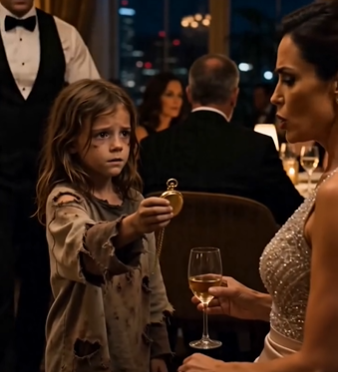
The glass shattered across the floor, but no one reacted.
Not the guests.
Not the waiter.
Not even the rich woman.
Because the sound of breaking crystal was smaller than the truth now standing beside her table.
She stared at the little girl as if the last twenty years had risen from the dark and come back wearing torn sleeves and frightened eyes.
The younger woman in the photograph was unmistakably her.
But the newborn in her arms was supposed to have vanished from history.
Years ago, before the diamonds, before the high-profile marriage, before her name became something people treated like power, she got pregnant by a man who would have destroyed her family’s reputation. Her father handled it the way powerful fathers handle inconvenient daughters: quietly, quickly, permanently. She was told the baby had been placed far away. Told it was mercy. Told forgetting was survival.
And she tried.
Until now.
The little girl standing in front of her was not there by accident.
The shape of the eyes.
The line of the mouth.
The familiar dimple that flashed even through fear.
The woman’s voice came out as a whisper.
“Your mother kept you?”
The girl nodded.
“Until she died.”
That line opened the room wider.
Because this was no blackmail scene.
No setup.
No random accusation.
It was a child who had lost the one person who protected her, now carrying the only proof that her life began in a lie.
The rich woman looked at the locket again.
Inside the photo, tucked behind the image, was a small folded strip of paper the girl had not even mentioned yet.
The woman pulled it out with trembling fingers.
On it, in her own mother’s handwriting, were the words:
Transfer completed. Child removed. No further contact.
That was when her face broke.
Not publicly.
Not dramatically.
Just enough for everyone at the surrounding tables to understand that the elegant woman in silk and jewels had just learned she had not abandoned a child by choice—
she had been made to believe the child was gone.
The girl watched her carefully.
Not with trust.
Not yet.
With the caution of someone who has only ever heard one version of this woman.
Then she asked the question that shattered whatever composure was left:
“Did you ever look for me?”
No one in the restaurant moved after that.
Because now the scene wasn’t about class, or scandal, or a homeless child interrupting dinner.
It was about a daughter walking into luxury
with a locket full of proof
and forcing the woman in the photograph
to choose whether she would finally look back.