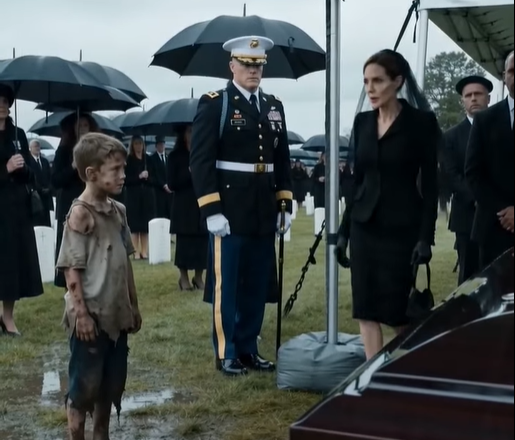
No one moved to pick up the glove.
No one bent toward the coffin.
No one even seemed to breathe.
Because suddenly the funeral was no longer about honoring a dead soldier.
It was about discovering who he really was.
The widow stared at the dog tags on the coffin like they were proof of a crime she had spent years dressing in black silk and burying under protocol.
The military officer looked from the boy to the widow and understood before the others did.
This was not a random child.
Not a grieving stranger.
Not some desperate lie.
The boy had his face.
Not completely.
But enough.
The eyes.
The line of the jaw.
The way he stood there trying not to cry in front of too many adults.
The widow’s voice came out brittle.
“Who is your mother?”
The boy answered softly.
And the name hit harder than the wind.
Because years ago, before promotions, medals, and state funerals, the dead soldier had loved a woman from the wrong side of every line his family cared about—poor, invisible, and impossible to introduce into the world the widow now stood protecting.
When she became pregnant, pressure came fast.
The family paid her to disappear.
The widow made sure the checks went through.
And the soldier was told she left with another man.
But he never fully believed it.
Years later, on a deployment leave stop in another state, he found her by accident — sick, broke, raising a child alone. By then, the damage was already done. He had another wife. Another life. A reputation built on silence. But he saw the boy once, knew immediately, and left those dog tags with him for one purpose only:
If I die before I fix this, bring these to my coffin.
The widow closed her eyes.
Because now the one secret she thought would die with her husband had arrived at the front of his funeral in torn clothes and wet shoes.
The boy’s voice shook for the first time.
“He said not to hate you.”
That made the widow open her eyes again.
Not because it softened her.
Because it condemned her.
Mercy from a dead man is harder to survive than accusation.
The military officer stepped closer to the coffin.
Looked at the tags.
Then at the boy.
And in front of the mourners, the flags, the polished military ceremony, he gave the child the same respect he would have given next of kin.
Because that is what the boy was.
Next of kin.
The son no one was supposed to know about.
The widow looked at the flowers, at the portrait, at the name she thought belonged safely to history.
But history was standing in front of her with mud on his cuffs and grief in his eyes.
And suddenly every ribbon, every speech, every medal pinned to the memory of the dead man meant less than the one truth finally spoken aloud:
he had a son.
And the child came not to ruin the funeral—
but to make sure his father was buried honestly.