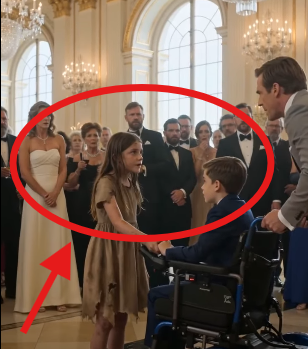
For one long second, no one in the palace hall moved.
Not the guests.
Not the servants at the edges.
Not even the man in gray.
Because the words “The lake house stairs” were impossible.
The boy himself looked stunned he had said them.
Like the memory had not come from thought, but from somewhere buried under years of silence.
His hand gripped the girl’s tighter.
And then, slowly, shakily, he pushed himself upward.
The crowd gasped as one.
Not because he stood fully.
Not yet.
Because he was trying.
Because until that moment, everyone in that room had lived under the same story:
the boy had lost the use of his legs after a tragic riding accident when he was younger. He remembered almost nothing. Doctors called the trauma severe. The family called it unfortunate. The palace called it private.
But the girl’s face said she knew better.
And now the boy, trembling beside the wheelchair, had just spoken the one place the official story never mentioned.
The lake house.
The man in gray recovered first.
Too fast.
“Sit down,” he snapped.
That was the wrong thing to say.
Because the command sounded familiar.
The boy turned toward him, and something dark and awakening moved across his face.
Not fear.
Recognition.
The girl spoke softly, like she was opening a locked door one word at a time.
“You weren’t hurt on the horse.”
The room went colder.
The boy’s eyes widened.
His breath came rough now.
She stepped closer.
“You fell on the stairs.”
A pause.
“He pushed you.”
The gasp that moved through the hall this time was not polite.
It was horrified.
The man in gray went pale.
Because he was not merely a guardian, or family friend, or trusted adviser. He was the boy’s uncle — the man who had stepped in after the accident, taken control of the estate, and spent years speaking for the heir who could no longer stand, no longer remember, and supposedly no longer question.
Until now.
The boy’s knees shook, but he stayed up, half-standing with one hand on the wheelchair and the other in the girl’s.
He stared at his uncle.
And memory came back in shards:
the argument at the lake house,
his father’s voice downstairs,
his uncle’s hand on his shoulder,
the push,
the fall,
the pain,
and then years of being told a different story so often it hardened into fact.
The girl’s voice trembled for the first time.
“My mother worked there,” she said.
“She saw it.”
That was why she knew.
Her mother had been one of the invisible women who cleaned the halls, changed sheets, carried trays — the sort of person the rich never look at long enough to realize they are witnessing everything. She had seen the fall. She had seen the uncle panic. She had seen the servants silenced and the report rewritten. And when she later died, she left her daughter the truth like a match meant for one exact room.
The uncle took one step back.
The boy stood straighter.
Not healed all at once.
Not magically saved.
But changed.
Because sometimes the body begins where truth is finally allowed back in.
Then the boy said the sentence that shattered the last of the lie:
“You didn’t save me.”
His voice shook.
But he kept going.
“You kept me broken.”
That ended the room.
The elegant guests were no longer an audience at a formal gathering.
They were witnesses.
And the barefoot girl in torn clothes was no longer an interruption.
She was the one person who had brought the heir back to himself.