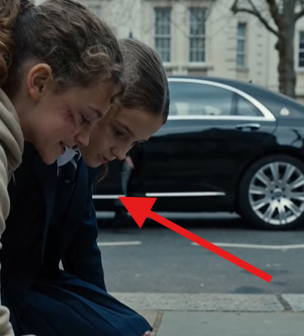
For one long second, the whole sidewalk went still.
Not the traffic.
Not the distant school chatter.
Not even the gate.
Only him.
Because he knew that signature.
He had seen it on birthday cards, recipe notes, the inside covers of children’s books, and every scrap of paper his wife ever touched before she died.
The street girl looked down at the card instinctively, like she wasn’t sure she was supposed to be holding it where other people could see.
The father’s voice came out lower than before.
“Where did you get that?”
The schoolgirl looked from him to the other girl, confused but still fiercely holding her hand.
The street girl swallowed.
“From the library van.”
A pause.
“She used to read to us.”
That hit him like a blow.
Because years ago, before illness took her, his wife had secretly funded a mobile library program for children in poorer neighborhoods. She said books should not stop at nice streets. She spent afternoons reading to kids in parking lots, church steps, shelters, and side streets — places his world barely looked at.
He had admired it.
But never really followed her there.
Now one of those children was standing in front of the school gate, holding his daughter’s hand and carrying the proof of a life his wife had touched without him ever noticing.
The schoolgirl lifted the notebook from the ground and clutched it to her chest.
“She explains it better than everyone,” she said.
“She makes it feel small.”
The father looked at the street girl properly for the first time.
Not the torn hoodie.
Not the messy curls.
Not the dirt.
Her steadiness.
Her gentleness.
The way she had looked at his daughter without envy, only patience.
Then he looked at his own child — brighter, calmer, braver than she had been getting out of that car in months.
And something in him gave way.
The street girl’s voice came quietly.
“She said rich kids get scared too.”
He blinked.
“Who said that?”
The girl looked at the card again.
“Your wife.”
That finished it.
Because suddenly this wasn’t just about a math lesson on the pavement.
It was about the invisible bridge his wife had built between two children from opposite worlds — one drowning in privilege and pressure, the other surviving on scraps but still rich in something rarer:
kindness without humiliation.
The father glanced at the gate, then back at the two girls.
Students were watching now.
Teachers too.
He could feel the whole polished world waiting to see which rule he would defend first:
the school’s,
or his daughter’s.
Emily made the choice easier by tightening her grip and saying the one sentence he could not ignore:
“You always said Mom helped the right people.
Well… she helped her.”
That broke the last of his resistance.
Because it was true.
And because, in that moment, he understood something painfully simple:
the child outside the gate had already done for his daughter what money had failed to do.
She had made her feel unafraid.
He stepped aside from the entrance.
Looked at the street girl.
Then at his daughter.
And said, softly:
“Then you both go in.”
The schoolgirl’s face lit up.
The street girl looked like she might cry.
And the grand iron gate, which had always divided who belonged from who didn’t, opened wide enough for both of them.