The boardroom was built for men who liked watching other people lose.
Floor-to-ceiling windows poured pale daylight across polished wood.
The skyline stood behind the glass like a second wall of power.
Around the long conference table sat executives in dark suits, expensive watches, and practiced expressions.
At the head of the table stood a dirty young boy in patched overalls.
Too small for the room.
Too poor for the carpet.
Too calm for the laughter moving around him.
The CEO in a navy suit slapped a sheet of paper down on the table in front of him.
A few executives laughed immediately.
Not because the boy had failed.
Because they were certain he would.
The CEO leaned back in his chair, enjoying the moment before it happened.
“If you can translate this, I’ll give you a million.”
The laughter lingered.
The boy didn’t flinch.
He stood with his arms folded, staring at the page like it was not difficult, not foreign, not impressive — only familiar.
That was the first thing that began killing the joke.
One executive stopped smiling.
Another shifted in his chair.
Because confidence like that does not belong to children brought in to be humiliated.
The CEO noticed it too, but pride made him smirk instead of reconsider.
The boy uncrossed his arms slowly.
“Fine.”
He stepped forward.
The room quieted.
Not completely.
Just enough.
He didn’t pick up the page right away.
He looked at the CEO first.
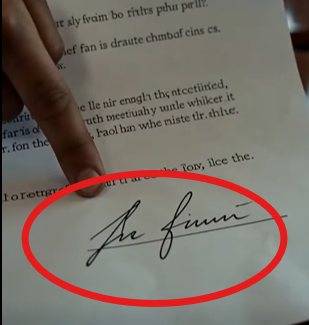
Then at the signature at the bottom of the document.
When he finally lifted it, his expression changed.
Not confusion.
Recognition.
His voice came out level.
“This isn’t a translation test.”
Now the room went still.
The CEO’s smile weakened.
Only slightly.
But everyone saw it.
“What did you say?”
The boy laid the page flat on the wood again.
He pointed at the bottom without taking his eyes off the man.
“It’s a confession.”
That landed like a crack in glass.
A woman halfway down the table went pale.
A man beside her straightened without realizing he had done it.
The CEO leaned forward now, irritation giving way to something sharper.
“Read it, then.”
The boy’s finger slid lower, stopping on the last paragraph.
His voice dropped.
More dangerous because it stayed so calm.
“Read the last line.”
The CEO leaned in.
His eyes scanned the page.
And all the color left his face.
Because written at the bottom, above the signature, was one sentence he recognized instantly —
one he thought had burned with the original document years ago.
The executives all looked down at once.
And just before anyone could speak, the boy said quietly:
“My father wrote that before he died.”
👉 CUT — Part 2 in the comments
🎬 PART 2 — “Why the CEO Went Pale”
For one long second, no one in the boardroom moved.
Not the executives.
Not the assistants by the door.
Not even the CEO.
Because suddenly the page on the table was no longer a test.
It was evidence.
Years earlier, before mergers and headlines turned him into a legend of industry, the CEO had a business partner — a gifted linguist and contract architect who read six languages, built impossible international deals, and knew exactly where every hidden clause lived.
He was brilliant.
He was inconvenient.
And when he discovered that the CEO had been laundering company losses into shell firms while using forged foreign contracts to bury the theft, he wrote a private statement — a confession in two languages, designed to survive destruction if only one version remained.
Then he disappeared.
The official story was simple.
Car accident.
No witnesses.
Closed casket.
Condolences.
The company moved on.
The CEO rose.
The confession vanished.
Or so he thought.
Now a dirt-covered boy in patched overalls stood at the head of the table with the dead man’s eyes and the dead man’s impossible timing.
The woman who had gone pale first finally whispered:
“Who are you?”
The boy turned toward her, but answered the whole room.
“My father said one day you’d all laugh before you listened.”
That line broke whatever pretense remained.
Because now everyone understood this had been staged on purpose.
The challenge.
The paper.
The confidence.
The boy had not wandered into the tower by luck.
He had come to choose the exact room where power would have to hear him.
The CEO tried to recover first.
“What is this?” he said, but the strength had gone out of his voice.
The boy looked at the document again.
“At the top,” he said, “it looks like an international mineral contract.”
A pause.
“At the bottom, in the second language, it says the profits were false, the signatures were altered, and the accident was arranged before he could go public.”
No one laughed now.
No one even pretended not to understand.
The man beside the pale woman slowly removed his glasses.
Another executive pushed his chair back half an inch, like distance might still matter.
The CEO’s hands flattened on the polished table.
“This is forged.”
The boy shook his head once.
“No.”
Then, from inside the bib pocket of his overalls, he pulled out a second folded page.
Older.
Stained.
Half-burned at the edge.
He set it beside the first.
Matching handwriting.
Matching signature.
Same final line.
Two versions.
The room changed all over again.
Because one could be doubted.
Two meant planning.
Two meant fear.
Two meant the dead man had known exactly what kind of room would one day need to see this.
The boy looked straight at the CEO.
“My father said if you ever saw me, you’d recognize the only thing you couldn’t buy back.”
The CEO stared at him in silence.
Because the boy wasn’t just carrying the confession.
He was carrying blood.
The same eyes.
The same jaw.
The same terrifying stillness before truth.
Then the boy tapped the final line again and read it out loud:
If this reaches the board, the man seated at the head of the table ordered my death and built his empire on the lie.
That finished it.
Not because the sentence was dramatic.
Because it was written for this exact room.
And suddenly the child they meant to mock for being poor was the only honest person at the table.