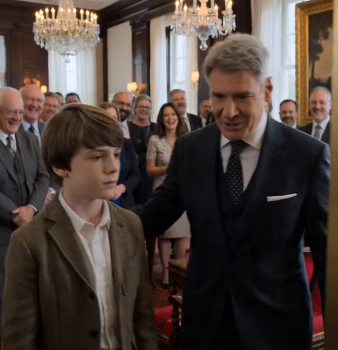
For one long second, no one in the room moved.
Not the guests.
Not the servants.
Not even the man holding the boy’s arm.
Because the question had cracked something open before the safe ever did.
Is your name still inside?
That was not the question of a child guessing.
It was the question of someone who had been sent.
The boy slowly lowered his eyes to the man’s hand gripping his sleeve. Then back to the man’s face.
And that was when everyone saw it:
the rich man was not afraid the safe would be damaged.
He was afraid it would be opened.
Years earlier, before the velvet jackets, before the high-society charity speeches, before he inherited the estate and polished his sins until they looked like success, the safe had been commissioned by one man only — the finest metalworker in the city. A quiet craftsman known for building locks no thief could guess and hidden chambers no client ever expected.
The boy’s father.
The same man who vanished after accusing the rich man of fraud.
At the time, society believed the version that was easiest to swallow: the craftsman became unstable, stole money, disappeared in disgrace. The rich man remained respected. The safe remained locked. And anyone who asked too many questions learned quickly that wealth is better at rewriting stories than it is at telling the truth.
But the craftsman had known he would not be believed.
So before he disappeared, he built one final secret into the safe.
A hidden compartment that could only be reached by someone taught the real pattern — not the owner’s pattern, but the maker’s.
His son’s fingers now moved with that exact memory.
The man in the suit loosened his grip without realizing he had done it.
The boy turned the final section of the wheel.
Click.
Something inside released.
The guests flinched.
The room seemed to tilt.
The man’s voice came out dry.
“Who sent you?”
The boy’s answer was small, but merciless.
“My father. Before he died.”
That line erased whatever performance remained.
Because now this was no party trick, no rich-man test.
It was inheritance.
Evidence.
A dead man’s last move.
The boy reached into the opening seam that had appeared behind the dial and pulled free a flat sealed packet wrapped in oilcloth.
The rich man took a half-step forward, but stopped when the child looked up.
Not because of force.
Because shame had finally entered the room.
On the packet, in the craftsman’s handwriting, were the words:
Open in front of witnesses.
Everyone there understood then that they already were.
The guests who laughed.
The guests who watched.
The guests who had come for spectacle and now found themselves standing inside a confession.
The boy held the packet against his chest.
Not greedily.
Protectively.
Then he said the line that ended the man’s control over the room:
“He said the safe never belonged to you.
Only the secret did.”
And suddenly the giant golden safe was no longer a symbol of the rich man’s power.
It was a trap built by a father who knew one day his son would come back for the truth.