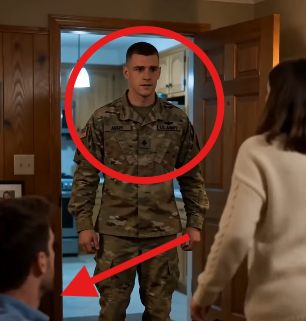
For one long second, nobody moved.
Not his wife.
Not the man with the watch.
Not even the soldier.
Because suddenly the betrayal had changed shape.
The affair hurt.
The watch hurt more.
But the drawing—
the drawing was a blade.
He bent slowly, picked it up, and held it between two fingers like something fragile enough to crumble and ugly enough to kill.
Three figures in crayon.
A woman.
A little child.
A man in blue.
Daddy Mike.
Not “uncle.”
Not a stranger’s name by accident.
Daddy.
The wife started crying harder the second she saw what he was holding.
Because now there was no story left to soften this.
Not loneliness.
Not confusion.
Not one bad decision.
Time.
Enough time for a child to name another man father.
The man in the blue shirt finally got the watch loose and held it out with shaking fingers.
The soldier didn’t take it right away.
He kept staring at the drawing.
Then he asked, very quietly:
“How long?”
No one answered.
That silence told him plenty.
He looked at his wife.
Not with rage.
With something worse.
Recognition.
Because all the signs he ignored while overseas came rushing back at once — the shorter calls, the way their son sometimes seemed hesitant on video, the strange pauses when he said “I miss you,” like someone had taught the child to miss him politely instead of naturally.
His wife whispered:
“It wasn’t supposed to—”
He looked up, and she stopped.
Because there is no sentence after that which saves anyone.
The man in blue took one step back, but nowhere in that living room was far enough from what had happened.
The soldier took the watch from his hand at last.
Turned it over.
Saw his own initials inside the clasp.
Then fastened it back on his own wrist without looking down.
That was when his wife understood the most painful thing in the room:
he was not breaking.
He was deciding.
The child’s bedroom door stood half open down the hallway.
A soft nightlight glowed inside.
The soldier looked toward it once, then back at the drawing.
His voice came out calm. Too calm.
“Does he call me that?”
The wife shut her eyes.
“No.”
That answer landed like a gunshot, even though the room stayed quiet.
Because now the real homecoming wasn’t at the front door.
It was this:
a father standing in his own house, wearing his own watch again, learning that while he was surviving war somewhere else, another man had been slowly replacing him in the one place he thought was safe.
He walked past them then.
Not toward the door.
Toward the hallway.
Toward the child’s room.
His wife reached for his arm, terrified now in a completely different way.
He pulled free without force.
And with the drawing still in his hand, he said the line that ended everything they had been pretending:
“I’m not here for you. I’m here for my son.”
That was when the room finally understood—
the man who came home in uniform did not walk in and find his marriage broken.
He walked in and found his fatherhood being erased.