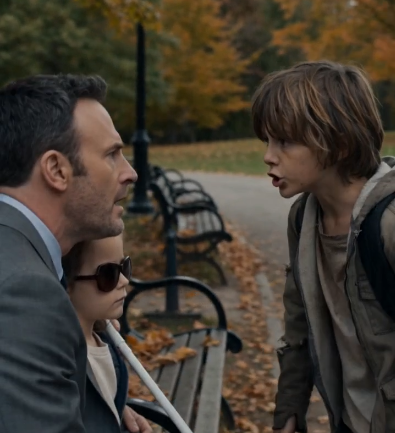
For one long second, the whole park seemed to hold its breath.
Not the leaves.
Not the distant footsteps.
Not even the wind.
Just the bench.
The father looked from the dirty boy… to his daughter… then toward the jogging woman moving along the path.
His wife.
At first, he wanted to reject it.
Children imagine things.
Street kids say anything.
Fear makes stories.
But then he looked at his daughter again.
Really looked.
Not as the little blind girl he had spent months protecting.
As a child who had become too quiet.
Too careful.
Too obedient.
The boy’s voice came smaller now.
“She cries after dinner.”
That landed harder than the accusation.
Because the father had seen that.
Every night.
The trembling mouth.
The silence.
The refusal to speak.
The way his wife always rushed to explain for her.
The father’s throat tightened.
“What does she put in it?”
The boy shook his head.
“I don’t know.”
A pause.
“White powder. From a little bottle.”
The girl beside him stayed silent, but her small hands had started trembling in her lap.
That was what finally shattered him.
Because children can lie with words.
But not like that.
Not with their whole bodies.
He knelt in front of his daughter and, with shaking hands, slowly removed her sunglasses.
She blinked against the gray light.
Then turned toward him.
Not perfectly.
Not strongly.
But enough.
Enough to destroy the lie.
The father stared at her, horrified.
She could see.
Maybe not clearly.
Maybe not fully.
But she could see.
And the worst part was not the betrayal.
It was the realization that his daughter had known she must pretend.
The boy clutched the straps of his backpack.
“My mom used to clean there,” he said.
“She saw your wife mix it.”
The father looked up sharply.
“Used to?”
The boy’s eyes filled.
“She got fired.”
That explained the fear.
Not just the child’s.
The mother’s too.
Because this wasn’t just cruelty.
It was concealment.
Someone had seen something.
Someone had to be removed.
The father looked back toward the path.
His wife was no longer jogging.
She had stopped.
And from across the autumn park, she was watching them.
Not confused.
Not worried.
Watching.
The little girl finally whispered, voice shaking with the weight of too much silence:
“Daddy… Mommy said I mustn’t tell you what I saw in Grandpa’s room.”
That was the real wound.
Not blindness.
Not illness.
A witness.
The little girl had seen something in her grandfather’s room before he died — papers, signatures, a bottle, maybe even hands moving things that should never have been touched. She was too young to understand it all, but old enough to remember. And once she started reacting, once she started looking too closely, her mother found a cleaner way to erase her truth:
not by killing her—
but by making the whole world believe she couldn’t see.
The father rose slowly from the bench.
And suddenly the park, the leaves, the quiet path — none of it felt gentle anymore.
Because the dirty little boy had not grabbed his sleeve to cause trouble.
He had come to save a girl
who had already been taught
that seeing the truth
was dangerous.