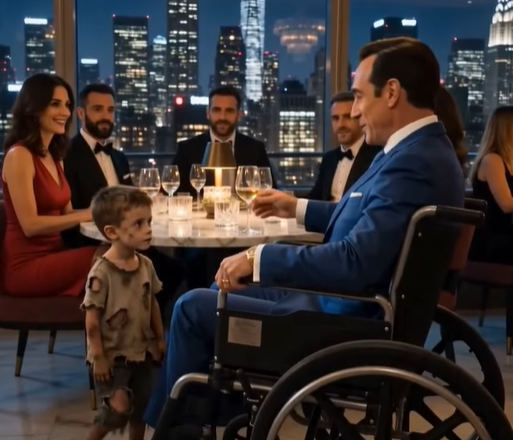
For one long second, nobody in the restaurant moved.
Not the servers.
Not the guests.
Not even the man in the wheelchair.
Because the boy’s last sentence had hit harder than the miracle.
My mother said you’d walk the day you saw me again.
That was not guesswork.
That was history.
The rich man stared at the child kneeling beside him, and suddenly the face in front of him was no longer just a dirty boy in torn clothes.
It was a wound.
Years earlier, before the fortune doubled, before the skyline dinners, before the expensive wheelchair became part of his image, there had been a woman. Not a society woman. Not someone acceptable. A healer from a part of the city rich men only drove through with the windows up. She knew herbs, nerves, pressure points, old body tricks doctors mocked in public and paid for in private.
And he loved her.
At least for a while.
Until ambition arrived heavier than love.
When she got pregnant, he did what powerful cowards do best: he paid for distance and called it necessity.
She disappeared with the baby.
Months later, he was shot during a business dispute and lost the use of his leg. Every specialist money could buy told him the same thing:
permanent damage.
He believed them.
Because he had to.
Now a child with the same eyes as that woman had just placed two fingers on his foot and awakened something medicine had buried.
The boy stood slowly.
Not triumphant.
Just sad.
The rich man’s voice came out dry and broken.
“Who is your mother?”
The answer was worse because it was simple.
“Anna.”
That name cracked the room open.
Not for the guests.
For him.
Because he had spent years pretending not to remember it clearly.
Now it was standing in front of him in the shape of a child and the movement of his own toes.
He pushed down on the table.
His legs shook.
The wheelchair creaked behind him.
And then — slowly, impossibly — he stood.
The room gasped as one.
But the miracle was not what made his face collapse.
It was the boy.
Because Anna had once told him, in anger and tears, that one day he would learn the cruel difference between being healed and being forgiven.
The boy reached into his pocket and placed a folded note on the table.
“She said to give you this after.”
His fingers trembled as he opened it.
Inside, in handwriting he knew instantly, were the words:
I could have healed you years ago.
But first you had to live long enough to understand what it feels like to lose a child who is still alive.
That hit harder than standing.
Harder than the shock.
Harder than the room watching him rise from the chair.
Because suddenly he understood:
this was never just a miracle.
It was judgment.
She had not sent the boy to beg.
Not to impress.
Not even to punish him with spectacle.
She sent him so the man who abandoned his son would stand on his own feet for the first time
at the exact moment he was forced to face the child he left behind.
The boy looked at him quietly.
And in that beautiful room above the city, surrounded by money, glass, and horrified silence, the rich man finally learned that being given back your legs means nothing if you still have to kneel before your past.