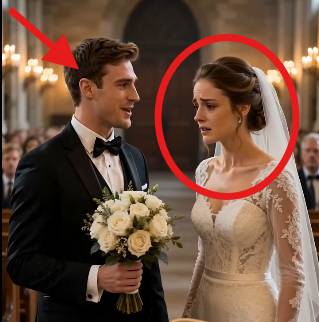
The older man looked at the groom for one long, heavy second.
Then he took the bouquet gently from the bride’s trembling hands and said, calm and clear,
“Yes. I knew.”
The church went dead silent.
The bride stared at him, tears still on her face.
“You’re really here,” she whispered.
He turned to her, and all the power left his expression. For a moment, he was not a wealthy man or a feared boss.
He was just a father looking at his daughter.
“I promised your mother,” he said softly, “that if any man ever made you cry like this, he would answer to me.”
A shiver moved through the church.
The groom took a step back.
“Sir, I didn’t know she was your—”
“Daughter?” the older man finished.
His voice stayed quiet, and that made it worse.
“No. You didn’t. Because she asked me not to tell anyone who she was. She wanted to be loved for herself.”
The bride covered her mouth and began crying harder.
The guests looked from her to the groom, understanding everything at once.
The older man faced the altar, then looked back at the man who had humiliated her.
“You failed the simplest test of character,” he said. “And you did it in front of God.”
The groom’s face collapsed.
“Please…”
But the older man was done.
“You are fired,” he said. “And you will never use my daughter’s name, or mine, to open another door again.”
The groom looked like he might fall where he stood.
The bride’s whole body shook, not from shame anymore, but from the sudden release of it.
Her father turned back to her and wiped one tear from her cheek with shaking fingers.
“You were never poor,” he whispered. “You were only surrounded by people too blind to see your worth.”
She let out a broken sob and fell into his arms.
And in the church where she thought her life had been destroyed, the man who came to abandon her was the one who walked out ruined.