The announcer dropped the microphone.
Feedback screamed across the arena.
The technician’s finger hovered over the switch.
Nobody breathed.
Not the crowd.
Not the cowboys near the gate.
Not the boy standing in the dirt with dust on his cheeks and terror in his chest.
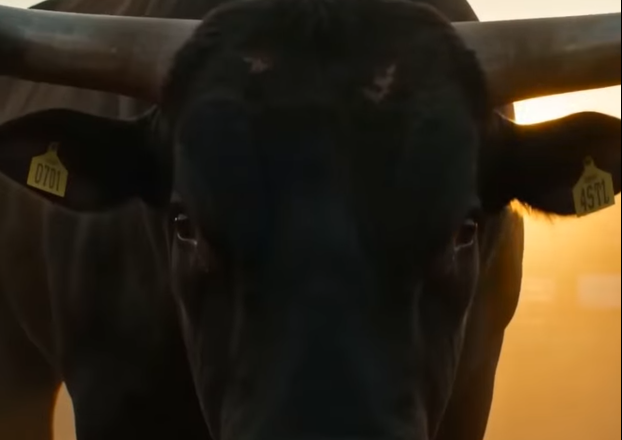
The bull’s body shook.
Not with rage.
With memory.
The boy lifted the whistle again, but his lips were trembling too badly to blow.
“Please,” he whispered. “Don’t make him hear it again.”
The announcer looked at the sound technician.
“Step away from that board.”
The technician didn’t move.
Then the boy reached into his jacket and pulled out an old photograph.
His hand shook as he held it up.
In the photo, a younger man stood beside the same black bull, one hand resting gently on its forehead.
The bull was calm.
Peaceful.
Almost proud.
The boy’s voice broke.
“My dad raised him.”
The crowd went silent.
Even the wind seemed to stop moving the pennants.
The announcer stared at the photo.
“What was the bull’s name?”
The boy swallowed.
“Atlas.”
The bull’s ears twitched.
At the name.
The boy heard it and started crying.
“He remembers.”
A woman in the front row covered her mouth.
The boy took one careful step toward the bull.
Everyone shouted for him to stop.
He didn’t.
“My dad said Atlas wasn’t dangerous,” the boy said, tears cutting lines through the dust on his face. “He said fear can make anything look like a monster.”
The technician backed away from the board.
Too late.
A sheriff climbed over the gate and grabbed his wrist.
Something small fell from the technician’s pocket.
A remote trigger.
The camera operator zoomed in.
The big screen showed it to everyone.
The crowd gasped.
The boy pointed at the trigger.
“They used the bell after shocking him,” he cried. “Again and again. Until he thought the sound meant pain.”
The announcer’s face collapsed.
The sheriff looked at the technician.
“Who told you to do this?”
The technician looked toward the sponsor box.
The wealthy sponsor in the white hat stood up slowly.
Then sat back down.
That tiny movement condemned him.
The boy turned toward the sponsor box, voice shaking with fury.
“My dad tried to stop you.”
The sponsor shouted, “Get that kid out of there.”
But no one moved.
The boy took another step toward Atlas.
The bull snorted, huge and frightened, but it didn’t charge.
The boy lifted the whistle and blew again.
One soft note.
The same note his father had used years ago.
Atlas lowered his head.
Slowly.
Carefully.
Until the boy’s shaking hand touched the space between his horns.
The entire rodeo arena watched a child calm the animal grown men had called savage.
The boy pressed his forehead against the bull’s face and whispered,
“I’m sorry they made everyone scared of you.”
The sheriff pulled the technician away from the sound board.
Deputies entered the sponsor box.
The announcer picked up the microphone with shaking hands.
His voice was no longer loud.
No longer theatrical.
Just ashamed.
“Ladies and gentlemen… this show is over.”
The crowd did not cheer.
They stood.
Quietly.
One by one.
Because now they understood.
The bull had not been performing.
He had been surviving.
And the boy had not run into the arena to prove he was brave.
He had run in because his father’s truth was about to be buried under applause.