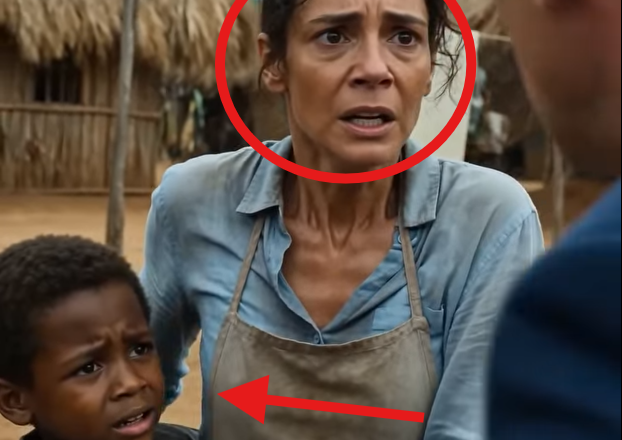
The man did not speak.
He only looked at the bottle in the boy’s hand.
The dark water moved slowly inside the glass, thick under the sunlight, like the river itself was too tired to flow.
His assistant whispered, “Sir, we should go.”
The woman’s eyes snapped toward him.
“No.”
The whole village heard it.
The assistant froze.
The man turned slowly.
“What did you know?”
The assistant forced a nervous smile.
“These people are confused. They blame the factory for everything.”
The boy stepped forward, still crying.
“I saw the truck.”
His voice shook.
But he did not stop.
“It came when the moon was gone. They opened the pipe near the old bridge.”
A murmur moved through the villagers.
An old man lifted his sleeve, showing a rash along his arm.
A young mother held up a baby with red marks on his neck.
Another child coughed behind a doorway.
The executive looked around for the first time.
Really looked.
Not at poverty.
At damage.
The woman reached under the washing table and pulled out a bundle wrapped in cloth.
Inside were more bottles.
Dates written on paper.
Photographs.
Letters.
All unanswered.
“I sent these to your office,” she said.
The man took one letter.
His own company stamp was on it.
Received.
Ignored.
His face changed.
The assistant stepped back toward the car.
The boy pointed at him.
“He was there.”
Silence.
The assistant’s hand stopped on the car door.
The man’s voice dropped.
“You told me the river tested clean.”
The assistant swallowed.
“The investors were coming. We needed time.”
The woman laughed once.
It wasn’t bitter.
It was broken.
“Time?”
She pointed toward the river beyond the trees.
“My husband went in that water to pull out a dead goat. Three days later, he couldn’t stand.”
The boy’s face collapsed.
“He was my dad.”
The executive looked at the child.
Mud on his knees.
Tears on his cheeks.
A bottle of poison in his hands because no adult with power had listened.
The man slowly removed his clean jacket and laid it on the muddy ground.
Then he knelt.
Not to comfort the boy.
Not yet.
First, he took the bottle with both hands like evidence.
Then he looked at the villagers.
“I did not know.”
The woman’s eyes filled with fury.
“But you should have.”
That hurt more than blame.
Because it was true.
The man stood and turned to his assistant.
“Call the police.”
The assistant whispered, “Sir—”
The man stepped closer.
“Not the office. Not the board. The police.”
The villagers began to move forward together.
Not attacking.
Witnessing.
The assistant looked at all of them and finally understood there were too many eyes now.
Too many bottles.
Too many children.
Too much truth.
The boy touched the man’s sleeve with muddy fingers.
“Will the river live?”
The executive looked toward the dark line of water beyond the village.
For the first time, he had no corporate answer.
Only a human one.
“I don’t know.”
His voice broke.
“But I’m going to stop pretending it isn’t dying.”