The wine glass shattered across the floor.
For the first time in her life, Vivienne did not care that every person in the restaurant was staring at her.
She could only see the child.
The dark eyes.
The small dimple beside her trembling mouth.
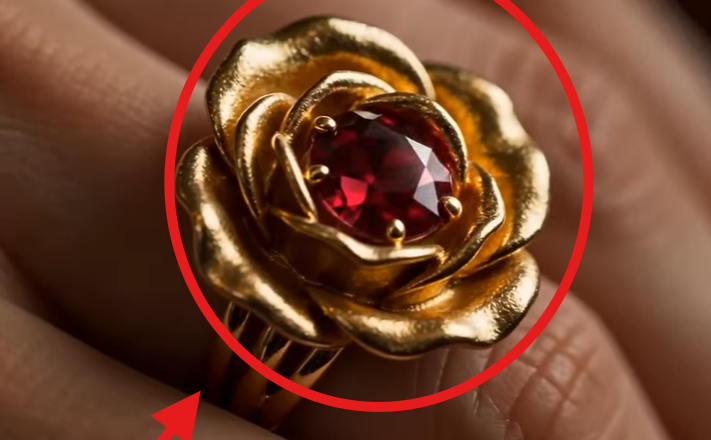
The ring hanging from a dirty string because no one had ever given her a proper chain.
“No,” Vivienne whispered. “My baby died.”
Mia pressed the folded note against her chest.
“My mother said you believed that.”
The word mother struck Vivienne harder than the shattered glass at her feet.
“Elena raised you?”
Mia nodded, frightened now.
“She was sick for a long time. Before she died, she told me not to sell this ring unless my brother was hungry.” Her voice became smaller. “He hasn’t eaten since yesterday.”
Vivienne looked at the scattered roses, at Mia’s scuffed shoes, at the sleeves hanging past her thin hands.
Her daughter had stood beside her table begging for coins.
And Vivienne had knocked everything she owned onto the floor.
She dropped to her knees so suddenly that several diners gasped.
“Mia,” she whispered. “Please… let me see the note.”
The child hesitated, then placed it in her shaking hands.
Vivienne recognized Elena’s handwriting before she read the first word.
Vivienne, your father lied to you.
Her breathing broke.
Your baby did not die. He paid the nurse to bring her to me because he said an unmarried daughter with a child would destroy the family name. I tried for years to reach you, but he found us every time. I am dying now. Her name is Mia. She has your eyes. Please forgive me for failing to bring her home sooner.
Vivienne covered her mouth, but the sob came through anyway.
Mia watched her carefully.
“My mom said you might hate me.”
Vivienne looked up as if those words had torn something open inside her.
“Hate you?”
Her lipstick was smeared now. Her perfect hair had fallen across her wet face. She no longer looked like the cold woman who had humiliated a poor flower seller.
She looked like a mother who had just discovered her child had been hungry only inches from her hand.
“I bought birthday gifts for you every year,” she sobbed. “I kept them in a room no one was allowed to enter because I couldn’t accept that you were gone.”
Mia’s chin trembled.
“Then why didn’t you find me?”
Vivienne closed her eyes.
There was no answer kind enough for that question.
“Because I believed the people who stole you from me.”
Mia looked down at the crushed roses.
“My little brother is waiting outside,” she whispered. “Elena took him in after his parents died. I promised I would bring food back.”
Vivienne slowly reached toward her, then stopped, afraid the child would flinch.
“Will you take me to him?”
Mia stared at her.
“Why?”
“Because no child of Elena’s will ever sleep hungry again.” Vivienne’s voice collapsed. “And because I have already lost nine years with you.”
Mia’s eyes flooded at last.
“You really are my mother?”
Vivienne lifted the matching rose ring from her own finger and carefully pressed it beside Mia’s.
The two red stones touched beneath the amber light.
“I am,” she whispered. “And I am so sorry the first thing I gave you was pain.”
That was when Mia began to cry.
Not quietly.
Not politely.
She folded forward like a child who had been brave for far too long, and Vivienne caught her against the black blazer Mia had been too afraid to touch moments earlier.
The wealthy diners went silent as the woman they admired sank onto the restaurant floor, holding the little flower seller as if no one else in the room existed.
Mia clutched her coat with both hands.
“Can my brother come too?”
Vivienne pressed her lips into her daughter’s messy hair.
“Both of you are coming home.”
Mia cried harder.
Then, through her sobs, she whispered, “Mom said you would know me by the rose.”
Vivienne tightened her arms around the child.
“She was right,” she said. “I should have known you before I ever saw the ring.”