Emily could hear the slow jukebox playing behind her, but the words on the paper made the whole diner disappear.
The handwriting was delicate and hurried.
My sweet Emily, if this reaches you, then I did not get the chance to come back.
Her vision blurred instantly.
Please believe this first: I did not leave you. I would never leave you.
Emily pressed a trembling hand over her mouth.
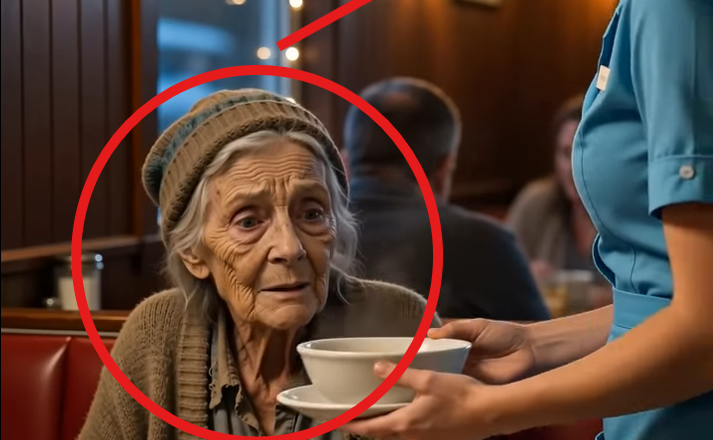
The old woman sat silently across from her, tears falling into the untouched soup.
Emily kept reading.
The owner found out I had proof he was stealing wages from the women who worked here. Tonight he threatened to take you from me if I went to the police. I hid the records where only you might someday find them: beneath the loose floorboard under booth seven.
Emily slowly looked down.
She was kneeling beside booth seven.
Her whole childhood had passed only inches above her mother’s hidden truth.
“I worked here since I was sixteen,” she whispered. “He told me he took me in because my mother didn’t want me.”
The old woman’s face broke with guilt.
“He took you in because keeping you close meant he could control the story.”
Emily looked toward the counter.
The diner owner stood there now, older and broad-shouldered, staring at the note in her hand.
His friendly face was gone.
“What did she give you?” he demanded.
Emily rose slowly.
The old woman reached for her sleeve, frightened.
“Your mother tried to run to the police that night,” she whispered. “I saw him follow her into the snow.”
Emily could barely force the words out.
“What happened to her?”
The owner stepped from behind the counter.
“Enough of this nonsense.”
The old woman pushed herself upright, frail body shaking, but her voice finally strengthened.
“I found her near the roadside,” she cried. “She was dying. She kept saying her daughter’s name.”
Emily’s knees weakened.
The man who had given her birthday cakes.
The man she had called Uncle Frank.
The man who had told her, over and over, that her mother chose freedom over her own little girl.
He had been standing behind the counter every day of her life.
Watching her believe him.
Emily knelt quickly and pried at the loose floorboard beneath the booth.
The owner rushed forward.
But two customers stood in his path.
The board came free with a dry crack.
Inside was a small metal tin wrapped in an old diner apron.
Emily opened it.
Payroll records. Photographs. A police statement her mother had begun but never delivered.
And beneath them all, a tiny photograph of Emily as a toddler, asleep against her mother’s chest.
On the back, written in the same trembling handwriting, were the words:
Every bowl of soup I give away is because I want my daughter to grow up in a world kinder than this one.
Emily’s sob escaped before she could stop it.
The old woman reached for her.
“I was too afraid then,” she whispered. “I have been hungry for years, but nothing hurt like knowing I failed your mother.”
Emily looked at the steaming soup still waiting on the table.
Then she took the old woman’s trembling hands and placed them around the warm bowl.
“You brought her back to me,” Emily cried. “You don’t have to be hungry anymore.”
Behind them, the owner turned toward the door.
A diner patron was already speaking to emergency services.
Emily held her mother’s photograph against her chest and finally allowed herself to grieve—not for a woman who abandoned her, but for the mother who had spent her final breath trying to leave her love behind.
Then she sat beside the frail stranger who had carried that love for twenty years and whispered:
“Eat, please. My mother would want you to.”