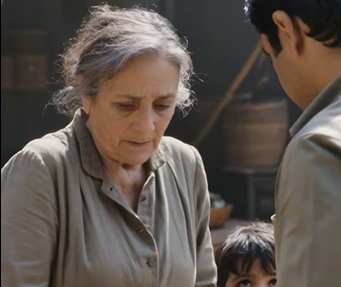
The owner stared at the boy, then back at the old woman, as if he were trying to force the past into the present.
His voice came out strained.
“What was your daughter’s name?”
The grandmother’s eyes filled instantly.
“Maria,” she whispered.
The owner shut his eyes.
That name had lived in his house for years like a wound no one touched.
His father had once told him that after the market fire, one family refused to sell the ruined land. They claimed it had been stolen while they were still searching for their missing daughter.
But the papers went through anyway.
The signatures appeared.
And soon after, the family disappeared into poverty.
The owner opened his eyes and looked at the old woman with horror.
“My father always said those signatures never felt right,” he said. “He believed someone forged them while your family was falling apart.”
The stall worker stood frozen, color draining from his face.
The grandmother clutched the boy’s hand tighter.
“My husband died trying to fight for that land,” she said. “My daughter spent years looking for proof. Then she died before she could get it back.”
The little boy looked up, confused, tears still on his face.
“Mom said someday someone would remember us,” he whispered.
That sentence hit harder than anything.
The owner looked at the child, then suddenly at the old woman’s cloth bag.
A folded envelope was sticking out.
Old.
Yellowed.
Protected too carefully to be worthless.
He pointed at it.
“What is that?”
The grandmother hesitated, then slowly pulled it free.
“It’s all she left me,” she said. “My daughter told me never to throw it away.”
The owner opened it with shaking hands.
Inside was an old market deed.
Half-burned at the edges.
Stamped decades ago.
And at the bottom, beneath soot and age, was the original family name.
Not transferred.
Not sold.
Still registered.
The owner’s face changed completely.
The land had never legally left their family.
The entire stall row — including the one where they had just been humiliated over a single candy — was standing on property that still belonged to the grandmother and her grandson.
A gasp moved through the crowd.
The worker took a step back.
The owner turned to him slowly, fury written across his face.
“You threw the rightful owner’s family out of their own stall.”
Nobody said a word.
Then the owner faced the old woman again and his voice broke.
“My father was right. Your family was robbed.”
The grandmother began to cry quietly, not from weakness, but from the exhaustion of carrying injustice for too many years.
The owner bent down, filled a large paper bag with honey candies, jars, fruit, warm bread, and sweets from three other trays.
He placed it gently in the boy’s arms.
The child stared at it in shock.
Then the owner stood and said loudly, so the whole market could hear:
“From this day on, every sale made here belongs first to her family until every lost year is repaid.”
The market went dead silent.
The worker nearly collapsed.
The boy looked up at his grandmother and whispered,
“Does that mean sweet is ours now?”
The old woman covered her mouth, sobbing.
And in the middle of the crowded market, where they had been humiliated for not having enough money for one candy, the truth finally came out:
they had never been poor because they had nothing.
They had been poor because everything had been taken from them.