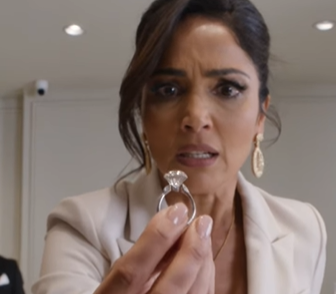
Not the customers.
Not the staff.
Not even the rich fiancée who had just slapped a poor girl in front of everyone.
The groom’s mother stood frozen near the door, her face emptying of color.
The groom turned slowly toward her.
“Mother,” he said, voice breaking, “why does Elena’s ring know this girl?”
The whole boutique went colder.
The assistant reached into her apron pocket and pulled out a tiny, yellowed key.
“I found it tied inside my mother’s burial box,” she whispered. “Under the cloth. Next to the ring.”
The old jeweler stared.
He knew that key.
It was the key to the private archive drawer where Elena’s original bridal papers had been sealed.
The groom’s mother took one step back.
“No,” she whispered.
The assistant’s tears kept falling, but her voice grew steadier.
“My mother was buried last month. She raised me under another name. Before she died, she made me promise that if your family ever touched me, insulted me, or called me a thief, I should bring the ring back here.”
The groom looked at her as if the room were splitting apart.
The old jeweler hurried to the archive cabinet, opened the hidden drawer with the key, and pulled out a thin velvet file wrapped in dust.
Inside were the original order papers for the ring.
Bride: Elena V.
Date: the same engraving inside the band.
But tucked behind the order sheet was something worse:
a folded church certificate.
The groom opened it with shaking hands.
It was a marriage record.
Not planned.
Not future.
Already done.
He and Elena had been secretly married three days before the family announced the engagement gala.
A gasp moved through the boutique.
The rich fiancée covered her mouth.
The groom’s mother closed her eyes.
The assistant whispered,
“She wasn’t your first bride.”
The groom looked up, shattered.
“She was your wife.”
No one breathed.
The old jeweler’s hands shook as he turned over one final paper in the file.
A burial release.
But the name on the coffin authorization was not Elena’s.
It was another woman’s name — a maid from the estate.
The whole room seemed to tilt.
The groom stared at his mother in horror.
“You buried someone else?”
Her voice came out thin and broken.
“Elena was pregnant,” she whispered. “Your father said if that child was born, the inheritance would split before the merger marriage could happen. She had to disappear.”
The assistant’s lips trembled.
“My mother told me she ran because they said the baby would not survive if she stayed.”
The groom looked at her face again.
The same eyes as Elena.
The same small curve of the chin.
His voice collapsed into a whisper.
“I’m your father…”
The rich fiancée staggered backward like she had been struck.
The assistant was crying openly now.
“My mother said you didn’t know,” she whispered. “She said you were locked away the night they took her.”
The old jeweler covered his mouth.
The groom’s mother began to cry, but nobody pitied her.
Because the truth was unbearable now:
the poor jewelry assistant humiliated in front of everyone,
called a thief,
slapped across the face—
was not stealing a ring.
She had brought back the proof that her mother had never been a dead first bride.
She had been a secret wife.
And the girl in front of them was the daughter hidden so the family fortune would stay clean.
The groom slowly took the ring from the tray and placed it into the assistant’s trembling hand.
Then he said, loud enough for the whole boutique to hear,
“This was never her engagement ring. It was my wife’s wedding ring. And she is not staff in this store.”
He looked at the crying girl and his voice broke completely.
“She is my daughter.”
The boutique fell into absolute silence.
And under the white diamond lights, in the very place where she had just been humiliated like she was nothing, the truth finally came out:
the “thief” had only returned to claim the marriage, the grave, and the name her family had buried with her mother.