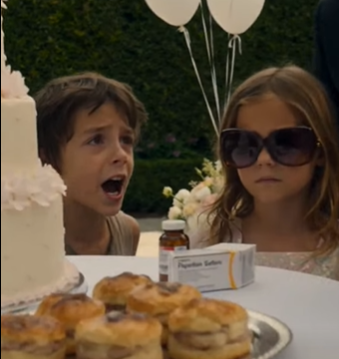
For one long second, no one at the party moved.
Not the guests.
Not the father.
Not even the children.
Only the little girl.
Her hands trembled as she lowered the dark glasses from her face.
Then she blinked.
Not blindly.
Not helplessly.
Into the sunlight.
The father stopped breathing for a second.
Because he saw it clearly now.
She flinched at the brightness.
Turned toward movement.
Focused slowly on his face.
His daughter was not blind.
She had been trained to live inside blindness.
The mother stepped forward fast.
Too fast.
And that was the worst part.
Not grief.
Not confusion.
Panic.
The homeless boy looked like he might run, but forced himself to stay.
“My mom heard her,” he said, voice shaking.
“She said the girl remembered.”
The father looked from the bottle… to the medicine box… to the little girl still holding the dark glasses in her hands.
Then everything that had felt wrong for months began to lock into place.
How the “condition” came suddenly.
How his daughter only got worse after meals prepared at home.
How his wife always insisted on speaking for her.
How the doctors kept saying the symptoms didn’t fully match.
The little girl looked at him and whispered the words she had apparently been forced never to say:
“I saw Mommy in Grandpa’s office.”
That was the real secret.
Not the medicine.
Not the blindness.
The child had witnessed something.
Days before the grandfather died, she had seen her mother changing documents in his study—estate papers, trust amendments, signatures that would redirect everything. She was too young to understand money, but old enough to remember rooms, voices, and what she saw done with a pen.
And once she started repeating it, the mother realized she had a problem.
Not a sick daughter.
A witness.
The easiest way to erase a witness was not to kill her.
It was to make the whole family believe she could no longer see the world clearly.
The guests were no longer guests now.
They were an audience to a collapse.
The father’s voice dropped into something cold.
“You drugged her?”
The mother’s face cracked.
“She would have ruined everything.”
That answer was worse than denial.
Because suddenly every white balloon, every flower arrangement, every expensive gift in the garden looked ridiculous beside what she had done to protect her life.
The homeless boy took one step back, tears running down his face.
He had not come for money.
He had come because his mother knew the little girl would never survive being silent forever.
And the birthday party, beautiful under the sun, had become the place where a child finally stopped pretending—
and exposed the person who taught her to.