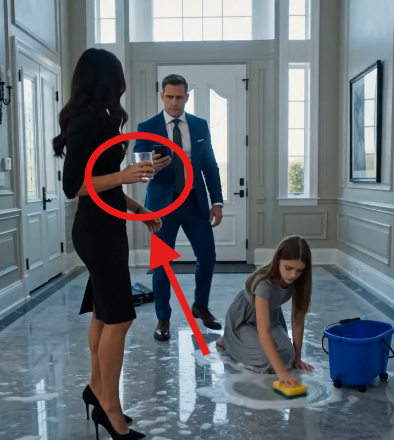
For one long second, no one in the foyer moved.
Not the woman.
Not the girl.
Not even the father.
Because the anklet was worse than the bucket.
Worse than the sponge.
Worse than the kneeling.
It meant ownership.
Not legally.
Not literally.
But cruelly.
The father stared at the small silver chain around his daughter’s ankle and felt something colder than rage settle into his chest.
Because he knew that anklet.
He had seen it before — not on a child, but in a velvet jewelry box upstairs among the woman’s monogrammed pieces. A decorative little thing she once laughed about at dinner, saying she liked initials on everything she “kept close.”
Now it was on his daughter.
The girl curled her toes inward, embarrassed that he had seen it.
That tiny movement told him everything.
This wasn’t one bad afternoon.
This was a system.
The father knelt in front of her properly now.
Not as a businessman.
Not as a man protecting his pride.
As a father who had come home too late.
His voice softened only for her.
“Who put this on you?”
The girl’s lip trembled.
She looked at the woman in black first.
Then back at him.
That hesitation was answer enough, but she whispered it anyway:
“She said I had to earn my room.”
The room changed after that.
The father closed his eyes for one second.
Because suddenly every odd thing from the past few months made sense — the child growing quieter, the nervous smiles on video calls, the way she always insisted she was “helping” when he asked what she had done that day, the strange distance in the woman’s voice whenever he called from work trips.
He had mistaken silence for adjustment.
Obedience for maturity.
Fear for shyness.
The woman in black found her voice again, but it was thinner now.
“You’re overreacting.”
He stood up slowly.
That was when she realized the worst thing possible:
he was no longer angry in a way she could argue with.
He was decided.
The father reached into his pocket, ended the phone call, and turned the screen toward her. She didn’t need to see the details to understand. The house transfer. The revoked access. Security alerts already moving. Her smile was gone now.
“Please,” she said, trying one last time to make it sound reasonable. “She needed discipline.”
The father looked at her the way people look at things they can no longer believe they once allowed near what they loved.
Then he answered, very quietly:
“She needed a mother. You gave her chores.”
That line finished it.
The little girl was still on her knees, but not because anyone was forcing her now.
Because she still hadn’t learned that she was safe.
He bent, slid one arm under her knees and the other around her back, and lifted her from the wet marble.
She held onto him too fast, too tightly.
That was what hurt the most.
Not that she cried.
That she clung like rescue was unfamiliar.
Her small hand caught at his collar.
And against his shoulder she whispered the sentence that shattered whatever strength he had left:
“I scrubbed before you came so she wouldn’t be mad.”
The father held her closer.
The woman in black said nothing after that.
Because some accusations are so complete they don’t need to be spoken by adults.
And in the cold white foyer, among soap streaks and dropped pride, the truth stood clear:
he had not come home to find a child helping around the house.
He had come home to find his daughter being trained to feel grateful for cruelty.