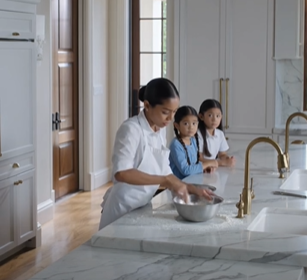
For one long second, no one in the kitchen moved.
Not the maid.
Not the girls.
Not even Mr. Villarreal.
The photograph lay on the marble between flour, sugar, and the life they had all been pretending was simple.
Because he had not come into the kitchen angry over baking.
He had come home angry because someone had mailed him that photograph an hour earlier.
No note.
No explanation.
Just proof that the woman raising his daughters inside his home was not a stranger to his family’s past.
Years ago, before money polished every surface of his life, his wife had one last request after the birth of their youngest child:
Keep her close. She saved me.
He thought she meant the maid had helped during illness.
During grief.
During childbirth.
But he never asked enough questions.
And after his wife died, pain turned him colder, harsher, easier to manipulate.
People whispered.
Servants talked.
A relative told him the maid had stayed too close to the children for a reason.
That she wanted money.
Inheritance.
Control.
So he walked into the kitchen ready to throw her out.
But the girls were looking at the photo now.
And the truth could no longer stay folded inside adults.
The maid’s hands trembled.
She finally looked at the oldest girl and whispered:
“Because I held you first.”
Mr. Villarreal stared at her.
“What does that mean?”
Tears filled her eyes now, but she didn’t look away.
Because there are moments when a lie rots so long it can only come out all at once.
Years earlier, his wife had given birth to twin girls.
One healthy.
One too weak to survive without constant care.
The hospital advised separation.
The family advised silence.
But his wife refused.
The maid — then a young live-in nurse — stayed by both babies day and night. When the weaker twin nearly died, it was the maid who kept her breathing through the night. Later, when postpartum complications took his wife’s strength and then eventually her life, she made the maid promise one thing:
Never let him send either of my daughters away.
Mr. Villarreal had never been told the full truth.
Because his own mother, terrified of scandal and disability touching the family name, had arranged paperwork that erased one child from the formal family record for months. The maid fought it. Quietly. Alone. And by the time it was reversed, she was the one the girls trusted most.
That was why she stayed.
Not to take something.
To protect what their mother had begged her to protect.
The oldest girl slid off the counter slowly.
Then pointed at the photo.
“There were two babies?”
Silence.
The maid nodded through tears.
And suddenly the whole kitchen felt different.
Not like a place where someone was being fired.
Like a place where a father was realizing how much of his own family had been hidden from him.
The smallest girl looked at him again and asked softly:
“Daddy… did Mommy make her stay?”
And that question hit harder than his anger ever had.
Because now the flour on the apron, the mixing bowl, the girls beside her — none of it looked inappropriate or strange anymore.
It looked like a promise being kept
long after the person who asked for it was gone.