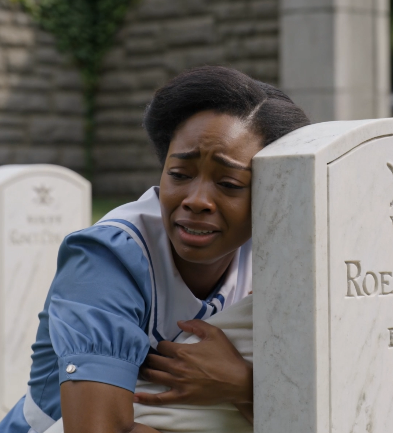
For one long second, the cemetery stopped feeling cold.
It felt exposed.
The older woman stared at the blanket as if twenty years of certainty had just cracked open beneath her feet.
Because before her son was deployed, there had been rumors.
A girl from town.
A relationship she considered beneath him.
Letters he begged her to mail.
A name he asked her never to forget.
Laila.
She had done more than forget it.
She had buried it.
When he died overseas, she destroyed the last letter that mentioned her. She told herself it was mercy. Mercy for the family name. Mercy for a future that could no longer happen.
But the future had happened anyway.
And now it was standing in front of her holding a child.
Her grandchild.
Laila’s eyes filled again, but this time not only with fear.
With anger too old to stay hidden.
“He wrote to me,” she said quietly.
“I never got the letters.”
The older woman couldn’t answer.
Because the silence was answer enough.
Laila looked down at the baby.
“He never knew,” she whispered.
“He died thinking I left.”
That hit harder than the grave itself.
The older woman’s face changed then.
Not into softness.
Into shame.
Because suddenly the polished suit, the careful posture, the family pride—all of it looked small beside the reality that her son died believing the woman he loved abandoned him, when in truth it was his own mother who made sure they were separated.
The baby stirred in Laila’s arms.
The older woman looked at the child’s face and saw it clearly now:
her son’s mouth,
her son’s brow,
her son’s impossible quiet when sleeping.
Her voice nearly failed her.
“How old is he?”
Laila answered softly.
And the number made the woman close her eyes.
Because the child had been born after the funeral.
After the folded flag.
After the speeches.
After the world had already decided her son’s story was finished.
But it wasn’t.
A piece of him had lived.
Poor. Unprotected. Hidden from the family that should have known.
Laila held the baby tighter and said the line that broke the moment open:
“I came here so his father would meet him first.”
That was when the older woman finally understood—
Laila had not come to beg.
Not to accuse.
Not to make a scene at a military grave.
She came because a dead man still deserved the truth.
And because a child should at least be known
by the stone carrying his father’s name
if not by the father himself.