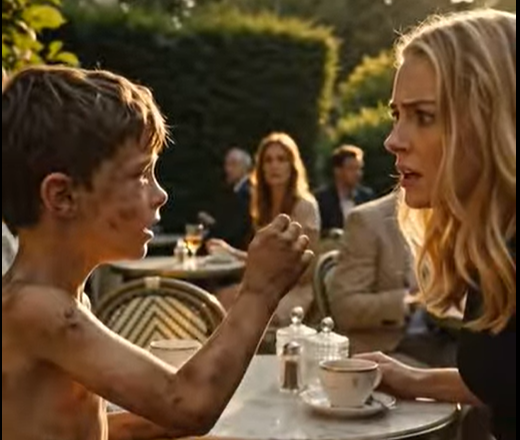
For one long second, the whole café seemed to stop breathing.
Not the cups.
Not the leaves.
Not even the quiet conversations nearby.
Just her.
The woman in black stared at the figure near the hedge like the past had stepped out of a grave and put on a beige suit.
Because years ago, when her older sister disappeared, the story had been clean and convenient: she ran away, she was unstable, she needed distance, she would come back when she was ready. Their father believed it because money makes lies easier to package. Their mother died without ever fully believing it. And the woman in beige remained close to the family, always calm, always useful, always just outside suspicion.
Now a dirt-covered child had walked into the one public place she visited every Thursday and placed her sister’s hair clip back into her life.
The boy’s voice trembled.
“She told me not to say her name first.”
The woman in black looked at him slowly.
Not because she didn’t understand.
Because she did.
Her sister had hidden the truth inside a child’s caution.
The woman in beige still hadn’t moved.
That was the worst part.
No panic.
No denial.
Just stillness.
Like someone who had spent years controlling where people went, what they knew, and who was allowed to come back.
The woman in black leaned closer to the boy.
“Is she alive?”
His lips shook.
“Yes.”
That one word hit harder than anything else.
Because suddenly all those years of mourning had not been grief.
They had been theft.
The boy clutched the jeweled clip tighter.
“She said you were the only one who still wore your hair like this.”
That broke something small and painful in the woman’s face.
Because she did.
The same side part.
The same loose wave over one shoulder.
The way her sister used to wear it before she disappeared.
She had never changed it.
Not intentionally.
Just because some losses settle into the body before you understand they’re staying.
The woman in black looked back toward the hedge again.
The beige-suited woman was already starting to turn away.
That was when the fear changed.
Not into panic.
Into certainty.
This wasn’t some strange coincidence or cruel trap.
Her sister had sent the boy because she could not safely walk to the table herself.
Because she was close.
Because she was watched.
Because the woman who stole her life was still standing in public pretending she belonged there more than the people she erased.
The boy finally whispered the line that split the whole beautiful evening open:
“She said if the lady by the hedge sees you first… we have to run.”
And suddenly the café was no longer an elegant terrace at sunset.
It was the place where a lost sister reached back through a child, a hair clip, and ten years of lies—
and gave her family one last chance
to choose whether they would freeze again
or finally follow the truth.