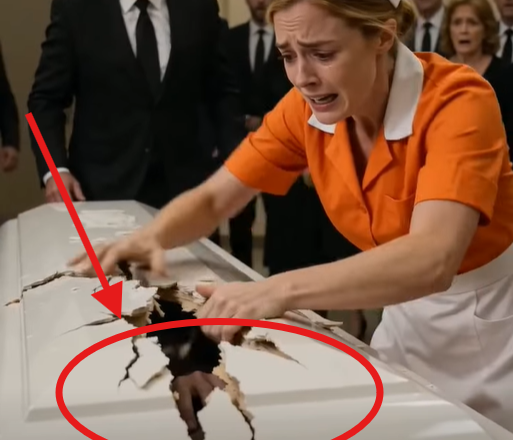
For one long second, nobody in the room understood what they were seeing.
Not the women in black.
Not the second man near the wall.
Not even the maid.
Only the lead mourner did.
That was why all the blood left his face at once.
Because the hand inside the coffin was wearing his ring.
The same thick gold family ring he had claimed he lost two days earlier.
The maid stared from the ring… to the man… then back to the coffin.
And suddenly her panic changed shape.
This was no mistake.
No miracle interrupted by bad timing.
This was a lie.
She had heard the sounds earlier while changing flowers in the preparation room. Soft knocks. A trapped breath. Something moving where the dead should not move. When she told the staff, they called her crazy. Told her grief was making her imagine things. Told her to go back to cleaning and keep her voice down.
But she had seen one more thing before the ceremony began:
the lead mourner slipping out of the private preparation room with blood on one cuff and terror hidden under his sorrow.
That was why she came back with the axe.
Not because she was wild.
Because no one else would listen in time.
The lead mourner took one step backward now.
That tiny movement told the whole room more than any speech could.
The maid ripped the broken lid farther open.
A second hand shoved weakly upward from inside.
Then a face appeared through the splintered gap—
not the dead woman they had all come to bury, but a living man, pale, gagged, and drugged, eyes barely open, wrists bound under funeral cloth.
The second man in the room staggered back into the wall.
One of the women screamed.
Because everyone there recognized him.
The dead woman’s lawyer.
The one who had vanished yesterday after saying he needed to “change the will before the service.”
The lead mourner was not mourning at all.
He was her son.
And he had hidden the lawyer inside the coffin to stop the truth from reaching the funeral.
The maid’s voice broke as she tore the cloth from the man’s mouth.
“Breathe. Breathe.”
The lawyer coughed hard and tried to sit up.
His first shaking finger pointed straight at the lead mourner.
That was enough.
The room already knew.
The son had not been arranging a burial.
He had been burying evidence.
The dead woman’s final will must have cut him out. The lawyer had come to enforce it. So the son drugged him, hid him in the coffin, and planned to let the funeral finish before anyone noticed the lawyer was gone.
And if the maid had stayed silent, a man would have been buried alive in a white coffin while everyone in black called it respect.
The lead mourner looked around the room once and understood the worst thing possible:
the maid in the orange uniform he thought no one would believe had just destroyed his perfect grief performance with one swing of an axe.
The lawyer finally forced out the words that shattered whatever control remained:
“The house isn’t yours.”
That finished it.
Not because the estate mattered most.
Because motive always makes horror easier to understand.
The son had not nearly killed a man in a coffin because he was mad.
He did it because he was losing everything.
And the maid, the one person nobody respected enough to hear the first time, became the only reason the truth made it out alive.