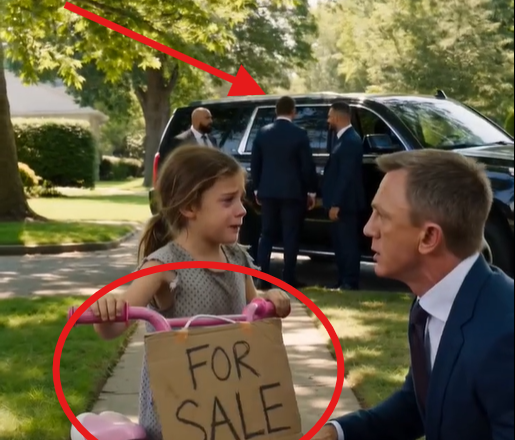
For one long second, nobody moved.
Not the men by the SUV.
Not the birds in the trees.
Not even the little girl.
Because her last sentence changed the whole street.
The wealthy man stopped halfway through tearing the sign loose.
His hand tightened around the cardboard.
Then slowly, very slowly, he looked back at the bike.
Not as a sale item.
As a clue.
He crouched again, but lower this time, close enough to see the little details a desperate child would never think to mention.
A scratched silver bell.
A faded ribbon tied under one handle.
And on the underside of the frame, almost hidden by dirt—
a tiny carved mark.
Two small initials.
The man’s whole face went still.
Because he knew that mark.
Years earlier, before the tailored suits and the black SUVs and the kind of money that made neighborhoods quieter when he entered them, there had been another life. A younger brother. Wild, stubborn, always fixing things with his hands. The brother carved those same initials into every bike, toy, and piece of furniture he built for anyone he loved.
Then one day he vanished.
No goodbye.
No body.
No proof.
Only debt, rumors, and silence.
The wealthy man had spent years telling himself his brother ran.
Now a hungry child stood in front of him holding a pink bicycle with his brother’s mark under the frame.
His voice came out rougher now.
“What was your father’s name?”
The little girl looked down.
Like the name itself still hurt.
Then she said it.
And that was enough.
The man shut his eyes for one second.
Because the child was telling the truth.
This wasn’t charity anymore.
This was blood.
The little girl’s lip trembled.
“He said if he didn’t come back, I should never sell it.”
A pause.
“But Mommy’s too hungry.”
That line broke whatever was left of the distance between them.
Because suddenly the bike was no longer just the last thing she owned.
It was the last promise her father ever made her.
And she was willing to break it to keep her mother alive.
The man stood and looked toward the SUV again.
This time when he spoke, it wasn’t like a businessman giving an order.
It was like a man who had just found part of his family starving on a sidewalk.
“Bring food. Bring the doctor. And call the house.”
The suited men moved instantly.
The little girl stared up at him, stunned, not sure whether to trust what was happening.
He turned back to her and gently removed the torn cardboard sign from the handlebars completely.
Then he folded it in half and put it in his pocket.
Her voice came out small.
“You’re really not buying it?”
He shook his head.
Not with a smile.
With something deeper.
“No,” he said.
“I’m taking you home.”
That was when the little girl finally started crying for real.
Not bargaining tears.
Not afraid tears.
The kind that come when hope shows up too suddenly to feel safe yet.
And the bright pink bicycle, still standing in the sunlight, was no longer something she had to lose.
It had become the thing that brought her father’s family back to her.