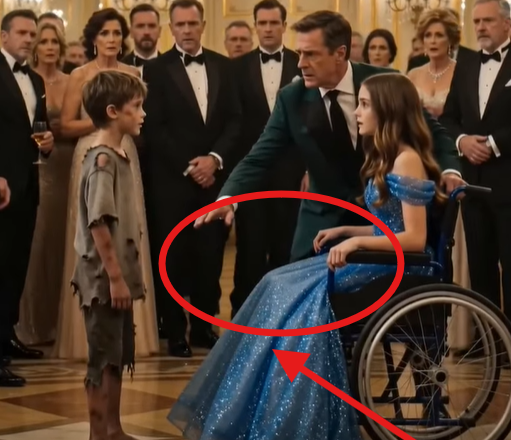
For one long second, the ballroom forgot how to exist.
Not the chandeliers.
Not the guests.
Not even the musicians waiting in silence.
Only the girl.
Her hand found the boy’s.
Small. Bare. Steady.
She pushed forward from the wheelchair with a look on her face no one there would ever forget — terror and hope mixed so tightly they had become the same thing.
Her father half-stepped toward her, then stopped.
Because sometimes love wants to protect so badly it becomes a cage.
And something in the boy’s face told him that if he touched this moment, he would break it.
The girl placed one foot down.
Then the other.
Her legs trembled.
The whole crowd gasped softly.
Not because they thought she would fall.
Because they understood how much she had already fallen before tonight.
Months earlier, after the accident, the doctors had given the family their careful language. Recovery would be long. Walking again was uncertain. Dancing was never spoken about at all. Her father bought the best chair, the best therapists, the best specialists money could command. But every expensive kindness came with quiet grief. He stopped letting her hope out loud because he couldn’t bear to watch hope fail her.
The girl learned that.
And slowly, she stopped saying the one thing she wanted most:
to dance.
But the boy had known.
Not because anyone told him.
Because he watched from the edges. He was the stable hand’s son, the one who ran errands through side corridors and polished shoes in kitchens where invisible people still hear everything. He had seen her at the ballroom doors at night, looking at the empty floor. Seen her fingers moving to music only she could still hear inside herself. Seen the way everyone protected her from disappointment until they were also protecting her from courage.
Now he held her hand like it was the simplest thing in the world.
“Just one step,” he whispered.
She took it.
The room broke.
Not loudly.
Emotionally.
Her father’s face collapsed first.
Not because she was fully healed.
Not because miracles had erased pain.
Because she was trying.
In public.
In fear.
In front of everyone.
The boy guided her gently toward the center of the floor.
No grand gesture.
No performance.
Just another step.
Then another.
The blue of her dress shimmered under the chandeliers as the wheelchair sat behind her, suddenly looking smaller than it had one minute ago.
The music rose.
The crowd began to clap.
Then louder.
Then all at once.
The girl laughed through tears, stunned by the sound of her own shoes against marble.
And when the boy slowly turned her beneath the gold light, she looked at her father with a face lit from the inside and said:
“Daddy… I’m really here.”
That was the line that destroyed him.
Because the cruelest part of losing a child’s old life is not the wheelchair, not the doctors, not even the fear.
It is the day they begin living beside themselves instead of inside themselves.
And now, for the first time since the accident, she wasn’t beside herself.
She was back.
Not all the way.
Not forever.
Not without trembling.
But back.
The boy let go for one second, and she stood on her own in the middle of the ballroom.
The guests burst into applause.
The father covered his mouth, shaking.
And suddenly everyone understood:
the barefoot poor boy had not interrupted the evening.
He had returned the one thing money, doctors, and pity never could—
her courage.